

Welcome to the Weintraub Tobin Resources Page

Browse below for news, legal insights, information on presentations and events, and other resources from the Weintraub Tobin legal team.


Do Secret Sales Bar Patents?

There is some confusion about what constitutes an “on-sale bar” in patent law. The on-sale bar, set forth in 35 U.S.C §102, prohibits a patent if the invention sought to be patented was offered for sale or sold more than one year before the patent application was filed. In other words, there is a one-year grace period after an offer for sale or sale in which a patent application may be filed. The earliest date of an offer of sale or sale is the critical date, often referred to as the “statutory bar date.” The reason for the on-sale bar is that once an invention is offered for sale, it is in the public domain, and no one should be able to patent something in the public domain.

If a patent issues and it is later found that there was an offer for sale or sale of the invention more than one year before the patent application was filed, the patent can be invalidated. The on-sale bar can be raised as a defense in patent infringement litigation to challenge the validity of the patent and it can be raised in a separate challenge to a patent’s validity.

Both the 2013 America Invents ACT (AIA) and the pre-AIA law include the on-sale bar in §102. Under pre-AIA §102(b), a patent is barred if the invention was on sale in the United States more than one year before the filing date of the patent application. The statutory bar applies regardless of whether the sale was public or secret. Under AIA §102(a)(1), the language of the statutory bar is different; a patent is barred if the invention was on-sale “or otherwise available to the public…” more than one year before the filing date of the patent application. Thus, the AIA broadened the scope of the on-sale bar to cover offers for sale and sales anywhere in the world, rather than just in the United States. However, the phrase “or otherwise available to the public…” created an ambiguity by implying that the on-sale bar only applies to public sales.

In Helsinn Healthcare S.A. v. Teva Pharmaceuticals USA, Inc. (Fed. Cir. 2017), the Federal Circuit Court of Appeals considered the on-sale bar, but did not resolve the ambiguity. Helsinn owned four patents covering a drug used to prevent nausea in patients undergoing chemotherapy. In 2001, Helsinn entered into a supply and purchase agreement with a pharmaceutical company, MGI. The parties announced the agreement in a press release and MGI filed a redacted copy of the agreement (excluding the price and the dosage terms) with the SEC. At the time the agreement was entered into, the drug was undergoing clinical trials and had not yet been approved by the FDA. In 2003, Helsinn filed a provisional patent application for the drug. In 2005 and 2006, Helsinn filed three utility applications claiming priority to the provisional, and, in 2013 filed one utility application claiming priority to the provisional. In 2011, Teva, a competitor of Helsinn, filed a new drug application in the FDA seeking approval of a generic version of Helsinn’s drug.

Helsinn sued Teva for patent infringement. Teva argued that all four patents were invalid based on the on-sale bar because Helsinn had entered into the supply and purchase agreement with MGI in 2001, over one year before the provisional application’s filing date in 2003. The trail court ruled in favor of Helsinn, holding that the on-sale bar did not apply. Teva appealed to the Federal Circuit.

The Federal Circuit explained that there is a two-part test for whether the on-sale bar applies. First, there must be a commercial offer for sale or a sale of the invention sought to be patented. Second, the invention must be “ready for patenting.” Pfaff v. Wells Electronics, Inc., 525 U.S. 55 (1998).

The court analyzed whether the Pfaff on-sale bar test was met. Three of the patents were governed by pre-AIA §102(b); one patent was governed by AIA §102(a)(1).

The court addressed whether the first part of the Pfaff test was met: whether there was a commercial offer for sale or sale more than one year before the patent application was filed. As for the three patents governed by pre-AIA §102(b), the court found that there was an offer for sale to MGI and that Helsinn had also marketed its drug to others. The court rejected Helsinn’s argument that there was no sale because FDA approval was a condition precedent to the actual sale, and there was no FDA approval at the time of the agreement with MGI. The court held that the need for regulatory approval or the existence of other conditions precedent do not mean that there is no contract for sale.

As to the one patent governed by the AIA, the court acknowledged that in enacting AIA §102(a)(1), members of Congress stated that the new §102 on-sale bar would apply only to sales in which the invention was made public, not to confidential sales as does pre-AIA §102. However, the court found that MGI’s filing of the supply and purchase agreement with the SEC was a public sale. The court held that it was irrelevant that certain specific terms of the agreement were not publicly disclosed.

The court did not address the key question of whether a confidential offer for sale or sale is an on-sale bar. Because most of the terms of Helsinn’s supply and purchase agreement were publicly disclosed, the court did not have to reach that question.

Next, the court addressed the second requirement of the Pfaff test: whether the invention was ready for patenting more than one year before the patent application was filed. This requirement is met if the invention has been reduced to practice (i.e., actually made and shown to work for its intended purpose) or if the invention has been described in writing in such detail that a person skilled in the art could make the invention.

Helsinn argued that its drug was not reduced to practice more than one year before it filed its patent application because it had not yet obtained FDA approval. The court stated the standard to obtain FDA approval is higher than the standard to show that a drug works for its intended purpose under patent law. The fact that more testing is required for an invention does not mean that the invention has not been reduced to practice. The court held that Helsinn knew that its drug worked for its intended purpose and therefore had reduced its invention to practice more than one year before it filed its patent application.

Because the Pfaff test was met for all four patents, the court held that the four patents were invalid based on the on-sale bar, reversing the district court.

After this decision, Helsinn filed a petition with the Federal Circuit seeking an en banc rehearing of the case. The Federal Circuit denied Helsinn’s petition. Helsinn has just filed a petition to the United States Supreme Court for writ of certiorari, asking the Court to answer the question of whether confidential sales fall within the on-sale bar. If the Court grants the petition, it will then have to decide whether Congressional intent was clear enough to change the approach of longstanding patent law.
Federal Circuit Weighs in on Reasonable Royalties as Patent Infringement Damages

In Exmark Manufacturing Company v. Briggs & Stratton Power Products, 2018 U.S. App. LEXIS 783 (Fed. Cir. 2018), the Federal Court of Appeals addressed patent infringement damages based on a reasonable royalty. Exmark Manufacturing Company owned a patent for a lawn mower with an improved flow control baffle (the part that controls the flow of air and cut grass underneath the mower). Exmark sued Briggs & Stratton Power Products for patent infringement. The jury returned a verdict of infringement against Briggs and found the infringement willful. The jury awarded Exmark $24 million in damages. The district court doubled the amount of damages for willfulness.

Briggs appealled to the Federal Circuit on multiple grounds, including the district court’s denial of Briggs’ motion for a new trial on damages.

Damages for patent infringement can be determined in several ways. At a minimum, a successful plaintiff is entitled to a reasonable royalty for the defendant’s sale of the invention. The royalty is calculated by multiplying a royalty rate by the royalty base (the defendant’s sales of the infringing invention). However, if the patent only covers a component of the product that the defendant has sold, the plaintiff must apportion damages between the patented component and the whole product. The plaintiff is only entitled to a reasonable royalty on the patented component, not on the whole product.

On appeal, Briggs contended that Exmark’s expert should have determined damages by apportioning the royalty base, not the royalty rate. The appellate court rejected Briggs’ argument and held that damages can be apportioned by apportioning the royalty rate, apportioning the royalty base, or a combination of the two.
The court stated, at *29:

“So long as Exmark adequately and reliably apportions between the improved in conventional features of the accused mower, using the accused mower as a royalty base and apportioning through the royalty rate is an acceptable methodology….The essential requirement is that the ultimate reasonable royalty award must be based on the incremental value that the patented invention adds to the end product.”

The court explained that apportioning damages using the sales revenue from the lawn mower was proper for two reasons. First, Exmark’s patent included claims to the mower as a whole, not just the component baffle. Second, parties who negotiate licenses often use sales revenue for the whole product as the royalty base for a patented component. Id. at *29-31.

Briggs also argued on appeal that Exmark’s damage number was not admissible because its expert did not connect the royalty rate to the facts of the case. The Federal Circuit agreed with Briggs and held the district court’s denial of Briggs’ motion for a new trial on damages was an abuse of discretion. Id. at *31.

The court found that Exmark’s expert’s use of 5% as the royalty rate was not connected to the evidence in the case. Under Georgia-Pacific Corp. v. U.S. Plywood Corp., 318 F. Supp. 1116 (S.D.N.Y. 1970), several specific factors may be considered in determining damages for patent infringement based on a reasonable royalty. These factors are referred to as the “Georgia-Pacific factors.” Exmark’s expert had analyzed certain of the Georgia-Pacific factors (including the advantages of the patented baffle to customers) and had determined that, in a hypothetical licensing negotiation, the parties would have agreed to a 5% royalty rate on the sales of the lawn mower. The expert did not tie the Georgia-Pacific factors to the 5% rate. Because the court held that Exmark’s expert had not connected the 5% rate to the Georgia-Pacific factors or the facts of the case, the expert’s opinion was inadmissible. The court remanded the case for a new trial on damages.

Some commentators believe that the Exmark court’s decision may increase plaintiffs’ ability to argue that a reasonable royalty should be based on the sales revenue from the whole product, not just the patented component. The court clearly held that apportioning damages between the whole product and the patented component can be accomplished by using the sales revenue for the whole product and apportioning the royalty rate. However, because the court rejected Exmark’s 5% royalty rate as not connected to the facts of the case, the court’s decision is also a warning that if a plaintiff chooses to use the sales revenue from the whole product and apportion with the royalty rate, they must clearly tie the royalty rate to the facts of the case.

Given this decision, it is likely that in the future, plaintiffs will use the sales revenue from the whole product, as it will be a larger amount than the sales revenue from the patented component, and apportion with the royalty rate.

Surviving Alice Challenges to Patent Claims

The Court of Appeals for the Federal Circuit just highlighted another approach plaintiffs can use to overcome early challenges to the validity of patent claims under 35 U.S.C. §101.   What is that approach?  It is a classic one:  show there is a genuine issue of fact.  That approach saved a subset of claims from summary judgment in Berkheimer v. HP.

Berkheimer sued HP for infringement of its patent “relat[ing] to digitally processing and archiving files in a digital asset management system.”  The system parses files into objects and “tags objects to create relationships between them.”  “The objects are analyzed and compared … to archived objects” to find variations.  “The system then eliminates redundant storage of common text and graphical elements” improving efficiency and reducing storage costs.

In an Alice challenge, HP moved for summary judgment that certain claims are not patentable under 35 U.S.C. §101.  In Alice v. CLS Bank, the Supreme Court recognized that “laws of nature, natural phenomena, and abstract ideas” are not patent-eligible subject matter under §101. To determine whether claims are patent eligible the Supreme Court set forth a two-part test in Mayo v. Prometheus as further explained in Alice.  This test consists of the following steps:

Step 1:  The court determines whether the claims are directed to an abstract idea.

Step 2:  If the claims are directed to an abstract idea, then the court determines whether the claims include elements showing an inventive concept that transforms the idea into a patent-eligible invention.  Step 2 is satisfied when the claim limitations “involve more than performance of ‘well-understood, routine, [and] conventional activities previously known to the industry.’”

“[W[hether a claim recites patent eligible subject matter is a question of law which may contain underlying facts.”  Any fact, however, “that is pertinent to the invalidity conclusion must be proven by clear and convincing evidence.”

The district court granted summary judgment that a number of claims of Berkheimer’s patent were invalid under §101.  On appeal, the Federal Court found the patent is directed to an abstract idea (Step 1) and then focused on Step 2 of the two-part test.  While the patent-at-issue relates to a technique for archiving files, Berkheimer argued that “portions of the specification referring to reducing redundancy and enabling one-to-many editing contradict the district court’s finding that the claims describe well-understood, routine, and conventional activities.” Berkheimer thus argued there was a fact question to which HP had offered no evidence.  The Federal Circuit agreed the validity of some of the claims turned on whether they cover “well-understood, routine and conventional” technology.  “Whether something is well-understood, routine, and conventional to a skilled artisan at the time of the patent is a factual determination.” Therefore, the Court found there was a genuine issue of fact as to whether the disclosed system archives files in an inventive manner that transforms the abstract idea into a patent-eligible invention.

Given the genuine issue of material fact, the Federal Circuit found that it was inappropriate to invalidate the claims at the summary judgment stage.  Note the Federal Circuit did not find the claims are directed to patent-eligible subject matter, but rather the district court judge should not have granted summary judgment given to the factual issue.

Therefore, a plaintiff’s patent can survive an Alice challenge in a motion to dismiss or motion for  summary judgment if the plaintiff can show a genuine issue of fact as to whether the invention is well-understood, routine, and conventional to a skilled artisan at the time of the patent.  Importantly, the Federal Circuit indicated not all cases involving Alice implicate questions of fact stating “not every §101 determination contains genuine disputes over the underlying facts…”  Thus “[p]atent eligibility has in many cases been resolved on motions to dismiss or summary judgment.”

In light of Berkheimer, it will be interesting to see whether district courts are now more hesitant to invalidate claims as patent-ineligible in early stages of litigation.

Stone Brewing Fires the Shot Heard Round the Brewing World

The fight between craft brewers and Big Beer (i.e. MillerCoors & Budweiser) has been ongoing for years. Ever since craft beer came to prominence in the late ‘90s, it has been stealing Big Beer’s share of the marketplace. In fact, craft beer has celebrated double-digit growth each year since then. In response, Big Beer has embarked on a course of action to recapture its share of the market.

In order to do so, certain members of Big Beer have acquired certain independent craft breweries, seemingly adopting the old adage, “if you can’t beat ‘em, join ‘em,” or in this case, “buy ‘em.” Now, by all means, mergers and acquisitions are part of business, and that’s fair play. But MillerCoors may have crossed the line when it decided to rebrand its Keystone brand as STONE, quickly catching the attention of craft brew powerhouse Stone Brewing, prompting Stone to file a complaint against MillerCoors in the United States District Court for the Southern District of California.

The complaint, which alleges trademark infringement, false designation of origin, trademark dilution, unfair competition, and declaratory relief, asserts that Stone Brewing has the exclusive right to utilize STONE in the brewing space. In fact, Stone has been utilizing STONE in conjunction with beer since as early as 1996, and subsequently registered the mark with the United States Patent and Trademark Office in 1998. Stone is one of the most well-known craft breweries in the industry and the ninth-largest independent craft brewer in the United States. It has even been recognized as the “All-Time Top Brewery on Planet Earth.”

MillerCoors, on the other hand, is a multinational beer conglomerate formed after a series of mergers involving Miller, Coors, and Canadian brewing conglomerate Molson. Keystone and Keystone Light is just one of many brands in MillerCoors portfolio. In general, the Keystone brand is regarded as sub-premium beer, which was formerly marketed in conjunction with the mark KEYSTONE and generally featuring imagery of the Colorado Rocky Mountains in the background. However, after Keystone’s sales dropped by approximately 25% from 2011 to 2016, and was named by USA Today as one of the “Beers Americans No Longer Drink,” MillerCoors opted to rebrand Keystone as STONE. Stone refers to the rebranding as an “aggressive second phase of the company’s pincer move against craft beer and Stone in particular.”

According to Stone, since the rebranding, which includes new cans, boxes, and logos emphasizing STONE as its primary mark, MillerCoors has launched a “viral marketing campaign that touts Keystone’s self-proclaimed new name,” and which “strategically plac[es] Keystone beer cans so that only ‘STONE’ is prominently displayed to viewers.” And if those allegations aren’t bad enough, Stone points out that MillerCoors encountered these same issues over a decade ago when it attempted to register STONES as a trademark and the USPTO refused the application because the examining attorney concluded the mark was confusingly similar to STONE. Still, MillerCoors has revived its attempt to rebrand Keystone with complete disregard of the USPTO’s prior conclusion. Although it’s almost certain that MillerCoors will have an explanation, whether believable or not, regarding the foregoing matters, this is highly favorable evidence for Stone.

Stone has not hidden behind its attorneys regarding this lawsuit. Just the other day Stone co-founder, Greg Koch, released a video on the internet expressing Stone’s frustration with the conduct of MillerCoors and indicating that Stone intends to vindicate its rights. Stone’s counsel also indicated that unless an immediate resolution is reached between the parties, Stone intends to pursue a preliminary injunction that would preclude MillerCoors from utilizing any of its new STONE branding until the case has concluded. Frankly, for all intents and purposes, that motion could be dispositive of the case, as the Court will be forced to make a determination regarding whether the Keystone rebranding is likely to cause consumer confusion. Regardless of which direction the Court comes out on that issue, it seems unlikely that the losing party will be able to sway the Court the other direction at trial, which would likely result in the parties negotiating a resolution.

We will be keeping a close eye on this matter as it progresses and will provide periodic updates. In the meantime, check out Greg Koch’s YouTube video where Koch represents that MillerCoors can “end all of this right here and now” if it just puts “the KEY back in KEYSTONE.” In my opinion, MillerCoors should probably listen to Koch as it seems they have a heavy burden to bear.

Copyright Infringement and Third Party Software Support

A recent case out of the Ninth Circuit, Oracle USA, Inc. v. Rimini Street, Inc. (July 13, 2017), illustrates some of the risks third party software vendors run concerning copyright issues.  Oracle develops and licenses proprietary “enterprise software” for business around the world.  A business using Oracle’s enterprise software would pay a one-time licensing fee to download the software and then can elect to buy a license maintenance contract that provides for periodic software updates.

Rimini provides third party support for Oracle’s enterprise software in lawful competition with Oracle’s own maintenance services. In the course of providing third party services, Rimini also is required to provide software updates to its customers.  It appears that between 2006 and 2007, Rimini obtained software and/or updates from Oracle’s website with automated downloading tools on behalf of several of its customers.

Oracle sued Rimini in 2010 and obtained partial summary judgment on parts of its copyright infringement claim.  After trial, the jury found in favor of Oracle on other claims (including computer abuse claims which are not discussed in this article) and awarded Oracle damages that totaled more than $120 million after interest, attorney’s fees and costs were added.  Rimini appealed the Court’s decision to the Ninth Circuit.

One of the primary issues addressed by the Ninth Circuit was whether Rimini copied Oracle software in a manner that gave rise to copyright infringement.  The evidence was undisputed that Rimini used Oracle’s enterprise software to help develop and test updates that it would then push out to its customers.  It appears that Rimini, while using the license for one of its customers to obtain the Oracle download, would then use the software to provide updates to other customers who either had Oracle licenses or were considering obtaining them.

Rimini argued that it should have prevailed on the copyright infringement claims by asserting two affirmative defenses, express license and copyright misuse.  As to the express license defense, the U.S. Supreme Court has long recognized that “anyone who is authorized by the copyright owner to use the copyrighted work in a way specified in the statute … is not an infringer of the copyright with respect to such use.”  However, a person could be liable for copyright infringement to the extent they exceed the scope of the license granted by the copyright holder.  Thus, the Ninth Circuit’s inquiry focused on whether Rimini was acting in excess of the scope of the licenses held by its customers.

The District Court had instructed the jury that it would not necessarily be copyright infringement by Rimini if it had used a customer’s license to develop updates for that particular customer.  However, it would be unlawful if Rimini was to use the license from one particular customer to develop updates to be used by others. The Ninth Circuit reasoned that Rimini’s use of one customer’s license to develop updates for other of its customers amounted to “cross use” and rejected Rimini’s claims that “cross use” is not infringement.  The Court found it significant that Rimini acknowledged that “cross use“ allows it to reduce expense to its customers by essentially “reusing work” performed for one customer.  The Ninth Circuit rejected this argument and agreed with Oracle by focusing on the language of the licenses that limited the scope of any authorized use to be done on behalf of that particular licensee.  By performing work for other customers, Rimini was exceeding the scope of any license and therefore was liable for copyright infringement.

Next, the Ninth Circuit turned to Rimini’s claim that Oracle was guilty of “copyright misuse.”  The copyright misuse doctrine prohibits copyright holders “from leveraging their limited monopoly to allow them control of areas outside the monopoly.”  In essence, the doctrine is intended to prevent copyright holders from stifling competition; however, it is not intended to prohibit the copyright holder from using conditions “to control use of copyrighted material.”  As a result, the copyright misuse defense should only be used “sparingly.”

Rimini argued that in essence, Oracle was “misusing” its copyright to prevent competition in the “aftermarket for third party maintenance.”  The Ninth Circuit rejected this argument finding that there was nothing wrong with requiring third party maintenance vendors to respect and comply with Oracle’s copyrights.

The Ninth Circuit’s decision in Oracle is a reminder that third party software vendors relying on their customer’s licensing of software or other computer programs need to be careful of running afoul of copyright laws.  Such vendors should obtain legal advice as to whether any of their proposed services run afoul of the software owners’/developers’ copyright interests.

U.S. District Court for the Central District of California Makes Rare FRAND Royalty Rate Determination

The U.S. District Court for the Central District of California recently issued its opinion in TCL Communications v. Ericsson (SACV 14-341 JVS(DFMx) and CV 15-2370 JVS (DFMx)) on standard-essential patents and whether a commit to license them was on terms that are fair, reasonable and nondiscriminatory, or FRAND.  The Court determined Ericsson did not offer to license its standard essential patents on reasonable terms, and instead become only the fourth U.S. Court to determine a royalty rate for essential patents.

Patent holders that own patents essential to industry standards often offer (or are required by the standard setting body to offer) to license their patents on FRAND terms when a patent is, or may become, essential to practice a technical standard, such as the wireless communications standards.  A patent becomes standard-essential when a standard-setting organization sets a standard that adopts the patented technology.  The acceptance of a patent holder’s patent into a standard is of great value to the patent holder, and enhances the monopoly which the patent holder has by virtue of the patent.  The accepted patents are often referred to as standard essential patents, or “SEPs.”  Anyone who wishes to manufacture products or provide services in accordance with the standard must now secure a license from the patent holder.  However, in exchange for acceptance of the patent as part of a standard, the patent holder must agree to license that technology on FRAND terms, which is typically a lower license rate than a standard (or non-FRAND) patent license in a comparable setting and with little ability to refuse to license.

Here, this case focused on the licensing of patents in the telecommunications field affecting 2G, 3G, and 4G1 cellular technologies.  Potential licensees TCL Communication Technology Holdings, Ltd. TCT Mobile Limited, and TCT Mobile (US) Inc. ( collectively “TCL”) manufacture and distribute cell phones on a world-wide scale.  Patent holders Telefonaktiebolaget LM Ericsson and Ericsson Inc. ( collectively “Ericsson”) hold an extensive portfolio of telecommunications patents.  TCL sought to license Ericsson’s patents, but the parties could not agree on terms.  The relevant standard setting organization at issue in this dispute is the European Telecommunications Standards Institute, or “ETSI.”

In beginning its analysis, the Court laid out the three tasks it needed to undertake.  The Court had to first “determine whether Ericsson met its FRAND obligation, and then whether Ericsson’s final offers before litigation, Offer A and Offer B, satisfy FRAND.  If they are not, the Court must determine what terms are material to a FRAND license, and then supply the FRAND terms.”

There were two principal schemes presented to the Court to consider in determining the proper FRAND rate, and if Ericcson offered to license at that FRAND rate.  One approach, offered by TCL, is a “top-down” approach which begins with an aggregate royalty for all patents encompassed in a standard, then determines a firm’s portion of that aggregate.  There other, offered by Ericcson, is an “ex ante,” or ex-Standard, approach which seeks to measure in absolute terms the value which Ericsson’s patents add to a product.  However, instead of just using one approach or another, the Court combined the two approaches.  Essentially, the Court undertook a non-discrimination analysis based principally on the review of comparable licenses.

At the end of the day, after conducting its analysis based on the combined hybrid non-discrimination approach, the Court reached the following conclusions:  “Ericsson negotiated in good faith and its conduct during the course of negotiations did not violate its FRAND obligation.  It is unnecessary for the Court to determine whether the failure to arrive at an agreed FRAND rate violated Ericsson’s FRAND obligation. Regardless of the answer to that question, the Court is required to assess whether FRAND rates have been offered in light of the declaratory relief which both sides seek.”

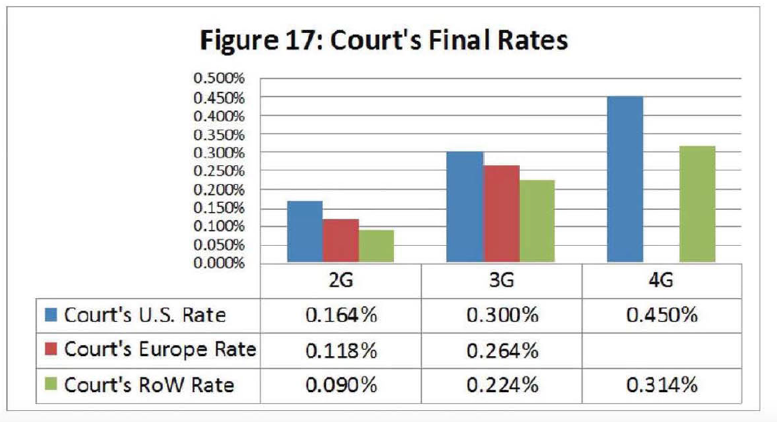
The Court then determined that Ericsson’s Offer A and Offer B were not FRAND rates and proceed to determine its own FRAND rates.  The court prescribed that the parties enter into a 5-year license agreement reflecting the FRAND rates, and TCL must pay Ericsson approximately $16.5 million for past unlicensed sales.  The FRAND rates determined by the Court were as follows:

In sum, if it stands, this case will likely make it easier for lower end product vendors like TCL to negotiate lower FRAND rates, and in turn more competitively offer their products in major markers.  It will also set a precedential approach to be used in future FRAND license negotiations and determinations.  However, Ericcson has already appealed this ruling to the Federal Circuit, so the final outcome is still far from over.

Ruling in Lawsuit Over Fox’s Use of “Empire” Extends Permitted Use of Third-Party Trademarks

Did you ever wonder why some movies use fictional names for companies or sports teams? TV and movie producers intentionally avoid using brand or company names in order to avoid any potential of an entanglement with a trademark owner.  Some studio lawyers insist that no third-party brands may be used under any circumstances without permission (I have had these discussions).  How do they explain that other producers, including the producers of HBO’s series, “Ballers”, use the actual names and logos of NFL teams within the show’s story without NFL permission?  Hopefully, the Ninth Circuit’s decision in 20th Century Fox Television v. Empire Distribution, Inc. will provide the legal framework by which these reticent studio lawyers may now approve the uncleared use of a third-party trademark.

Empire Distribution is a record label that records and releases albums in the urban music genre, which includes hip hop, rap, and R&B.  In 2015, Fox launched the TV series, “Empire”, a drama about a fictional New York based record label.  The show features music in each episode, including some original music.  Under an agreement with Fox, Columbia Records distributes the music from the show under the brand Empire.

Believing that its marks were being infringed, Empire Distribution sent Fox a cease and desist letter; Fox filed suit on March 23, 2015, seeking a declaratory judgment that the Empire show and its associated music releases do not violate Empire Distribution’s trademark
rights. Empire Distribution promptly filed a counterclaim for, among other claims, trademark infringement.

In most instances, likelihood of confusion is the method for determining trademark infringement.  However, when the allegedly infringing use is in connection with an expressive work, courts in the 9th Circuit will apply a different test developed by the Second Circuit in Rogers v. Grimaldi, 875 F.2d 994 (2d Cir. 1989).  Courts apply this different test primarily because such situation implicates the First Amendment right of free speech which must be balanced against the public’s interest in avoiding consumer confusion.   Sometimes a brand will acquire cultural significance and a storyteller may seek to use such significance to advance a storyline.

Under the Rogers test, the use of a third-party mark in an expressive work in not trademark infringement if the use of the third-party mark has artistic relevance and is not expressly  misleading as to the source or the content of the work.  Trademarks that do more than just identify goods, marks that “transcend their identifying purpose”, are more likely to be used in artistically relevant ways.  However, a trademark mark that has no meaning beyond being a source identifier is more likely to be used in a way that has “no artistic relevance.”

The court easily found that Fox’s use of “Empire” for both the title of its series and the name of the record label at the center of the show’s drama had artistic relevance and its use was not misleading.  However, Empire Distribution took issue with use of the “Empire” mark “as an umbrella brand to promote and sell music and other commercial products” such as appearances by cast members in other media, radio play, online advertising, live events, and the sale or licensing of consumer goods.

How far would Fox’s legitimate use extend?  According to the 9th Circuit, quite far.  The court acknowledged that while the above promotional efforts “technically fall outside the title or body of an expressive work, it requires only a minor logical extension of the reasoning of Rogers to hold that works protected under its test may be advertised and marketed by name.”  If the court did not extend Rogers to cover legitimate marketing and advertising endeavors, Fox would not have been able to effectively promote and market its TV program.

This is a good case for TV and movie producers and also the studios that market and promote their works.  For brand owners (like Empire Distribution), it’s also clear that acceptable use under Rogers is broad enough to include any activity whose purpose includes the promotion and marketing of the creative work.

Contingent Patent Ownership is Not Sufficient for Federal Court Jurisdiction

There is no federal court jurisdiction for disputes involving patents where the claimant does not actually own the patents. The possibility that one might own a patent, if a contingent future event occurs, is not enough. This seems like an obvious rule, but it ended up before the Federal Circuit Court of Appeals.

The case is First Data Corp. v. Inselberg  (Fed. Cir. 9/15/17).  The defendants were Eric Inselberg, an inventor, and his company, Inselberg Interactive, LLC.  Inselberg Interactive owned several of the inventor’s patents.  In connection with a loan transaction in which Interactive borrowed money from Frank Bisignano, Interactive gave Bisignano a security interest in the patents.  After Interactive defaulted on the loan, Interactive was required to, and did, enter into an assignment agreement with Bisignano. Interactive assigned all of its rights in the patents to Bisignano.  Bisignano then became the CEO of First Data Corp.

Several years later, Inselberg told Bisignano that First Data was infringing the patents and did not have a license. Inselberg demanded that First Data either buy the patents or license them, contending that the assignment Interactive had made to Bisignano was not valid. Bisignano then licensed the patents to First Data. Inselberg continued to assert that First Data was infringing the patents. Inselberg’s counsel sent Bisignano and First Data a draft complaint that Inselberg stated he intended to file in state court, alleging that Inselberg owned the patents and could sue First Data for patent infringement.

Bisignano and First Data jumped the gun and filed suit in the federal district court for the District of New Jersey.  The complaint sought a declaratory judgement that Bisignano owned the patents and that the license to First Data was valid. The complaint also sought a declaratory judgement that First Data did not infringe the patents because Bisignano owned the patents and had licensed them to First Data.

Inselberg and Interactive filed suit in New Jersey state court, seeking a declaratory judgment that they owned the patents because the assignment to Bisignano was invalid. Bisignano and First Data answered the complaint and filed counterclaims seeking a declaratory judgement of noninfringement of the patents and of invalidity of one of the patents. The defendants then removed the state court action to federal court, relying on the district court’s jurisdiction over patent cases.

In the federal court action, Inselberg and Interactive moved to dismiss Bisignano and First Data’s complaint and their counterclaims in the removed action, and sought remand of the state law claims.

The district court granted the motion to dismiss on the grounds that the federal court had no jurisdiction because there was no federal question. The district court found that Inselberg and Interactive had conceded that Bisignano owned the patents by seeking to invalidate the assignment agreement in their state court complaint, and, therefore did not own the patents. The district court held that Inselberg and Interactive did not have a claim for patent infringement and would not have such a claim unless they obtained ownership of the patents under their state law claims. Thus, the patent claims were contingent on the outcome of Inselberg and Interactive’s state law claims.

On appeal, the Federal Circuit affirmed the district court’s order dismissing Bisignano and First Data’s federal claims and remanding the state law claims. The court held that there was no federal question jurisdiction because Inselberg and Interactive did not, and could not, assert a threat of infringement against First Data as Inselberg and Interactive did not own the patents. In addition, the court held that Bisignano and Frist Data had no standing to assert their declaratory judgement claims.  For similar reasons, the court also held that Bisignano and Frist Data’s claims were not ripe for adjudication because all of the claims were based on a contingent future event, the state court awarding ownership of the patents to Inselberg and Interactive.

Federal Circuit Clarifies Waiver of Venue Issue in Light of TC Heartland, but Issues Still Remain For District Courts to Address

The U.S. Supreme Court’s May 22, 2017 ruling in TC Heartland v. Kraft Foods held that personal jurisdiction alone does not convey venue for patent cases under the patent venue statute.  Previously, the Court of Appeals for the Federal Circuit and the United States district courts had interpreted the patent venue statute, 28 U.S.C. §1400(b), to allow plaintiffs to bring a patent infringement case against a domestic corporation in any district court where there is personal jurisdiction over that corporate defendant.  Specifically, the patent venue statute provides that “[a]ny civil action for patent infringement may be brought in either 1) the judicial district where the defendant resides” or 2) “where the defendant has committed acts of infringement and has a regular and established place of business.”  But, TC Heartland, held that a domestic corporation resides only in its state of incorporation for purposes of the patent venue statute, and not just anywhere it is subject to personal jurisdiction as had previously been the case.

Following TC Heartland, corporate defendants filed a flurry of motions to dismiss for lack of venue or, in the alternative, to transfer cases.  Corporations argued they had been improperly sued in venues where they had no regular and established place of business, and where they are not incorporated and thus did not reside.  But, the Supreme Court’s ruling in TC Heartland led to confusion as to whether such challenges could be made in on-going cases where the defendant had not previously raised the issue of improper venue.  Specifically, Federal Rule of Civil Procedure 12(h)(1)(A), provides for waiver, based on the incorporated terms of Rule 12(g)(2), when a defendant omits an available venue defense from an initial motion to dismiss.  This confusion led to widespread disagreement among District Courts on the issue.

However, in In re Micron Tech, Inc., No. 2017- 138, 2017 WL 5474215 (Fed. Cir. Nov. 15, 2017) (“In re Micron”) the Federal Circuit recently clarified that TC Heartland was a change-of-law relevant to waiver under Rule 12(g)(2) and (h)(1)(A).  The Federal Circuit held that TC Heartland changed the controlling law such that at the time of an initial motion to dismiss, before the Supreme Court decided TC Heartland, a venue defense based on TC Heartland’s interpretation of the venue statute was not “available,” thus making the waiver rule of Rule 12(g)(2) and (h)(1)(A) inapplicable.  In other words, the venue objection was not available until the Supreme Court decided TC Heartland because, before then, it would have been improper given controlling precedent, for a district court to dismiss or to transfer for a lack of venue.

In further explaining its reasoning, the Federal Circuit first noted “[t]he crucial condition for Rule 12(g)(2) to apply, and hence for the unmade venue objection to be waived under Rule 12(h)(1)(A), is that the venue defense had to be ‘available to the [defendant]’ when the defendant made the initial Rule 12(b) motion.”  The Federal Circuit continued, “[w]here controlling law precluded the district court, at the time of the motion, from adopting a defense or objection and on that basis granting the motion, it is natural to say, in this context, that the defense or objection was not ‘available’ to the movant.  The law of precedent is part of what determines what law controls. The language ‘was available’ focuses on the time of the motion in the district court, not some future possibility of relief on appeal, thus pointing toward how the district court may permissibly act on the motion at the time—i.e., where the motion is for dismissal, whether it can dismiss the case and thereby avoid wasting resources on continued litigation. Because what Rule 12(g)(2) addresses is the omission of a defense or objection from an initial motion for one of the forms of relief specified in the Rule, subsection (g)(2) is naturally understood to require the availability of that relief at the time of the initial motion (here, dismissal based on improper venue).”

Importantly, however, the Federal Circuit limited its holding to only waiver under Rule 12(g)(2) and h(1)(A), and said there are still circumstances in which a district court can find that a defendant has forfeited its venue defense.  “[T]hat waiver rule, we also conclude, is not the only basis on which a district court might reject a venue defense for non-merits reasons, such as by determining that the defense was not timely presented.”  For example, “nothing in the Federal Rules of Civil Procedure would preclude a district court from applying other standards, such as those requiring timely and adequate preservation, to find a venue objection lost if, for example, it was not made until long after the statutory change took effect.”  Thus, the Federal Circuit concluded, “it clear that, apart from Rule 12(g)(2) and (h)(1)(A), district courts have authority to find forfeiture of a venue objection.”  Moreover, the Federal Circuit also made clear it was not exploring the contours of timeliness outside Rule 12(g)(2) and (h)(1)(A), or how to assess what constitutes consent to venue, or what if any other considerations could justify a finding of forfeiture even when the defendant has not waived its objection under Rule 12(g)(2) and (h)(1)(A).  In other words, the Federal Circuit limited its holding and left a number of open issues for District Courts.

Indeed, in Intellectual Ventures II LLC v. FedEx Corporation et al, 2-16-cv-00980 (TXED November 22, 2017, Order), a District Court in the Eastern District of Texas has already found that defendants waived their venue defense through litigation conduct in light of In Re Micron, and denied defendants’ motion to dismiss plaintiff’s patent infringement action for improper venue.  In reaching its decision, the District Court first noted that the Federal Circuit in In re Micron “explained that district courts possess an inherent power to find a venue objection forfeited based on conduct or other circumstances.”  The District Court then reasoned that “it was not until a few days after their IPR petitions were denied and more than two months after [TC Heartland LLC] was decided that Defendants finally sought to dismiss this case for improper venue.”  The District Court continued that In re Micron “does not invite defendants who have substantially engaged in a case to reassert an abandoned defense once it becomes convenient or advantageous for them. . . . Moreover, before TC Heartland was decided . . . Defendants sought to transfer this case to the Western District of Tennessee under § 1404 rather than § 1406. This is particularly significant because a motion under § 1404 is premised on venue being proper in the transferor court whereas a motion under § 1406 reflects an objection to the current venue as being improper.”  Accordingly, the District Court concluded that Defendants’ venue objection has been waived based on their own conduct, the judicial resources already expended in this case by the Court, the prejudice to Plaintiff in reopening a dormant venue dispute simply because it has become convenient for Defendants to litigate the issue now, and in light of all of these considerations taken together.

In sum, although In Re Micron clarified waiver of venue under Rule 12(g)(2) and (h)(1)(A) in light of TC Heartland, there are still a number of issues that need to be worked out at the District Court level.  And, it is likely there will be differing application across District Courts until more of these issues are worked out.

Would Glue Maker’s Trademark Claim Stick Against Pot Strain

According to cannabis folklore, cannabis cultivators in 2010, Josey Whales and Lone Watie  created a strain of marijuana that was so sticky, Mr. Whales, during a phone call, commented that the plant made his hands “stick to things like Gorilla Glue.”  From that, Whales and Watie came up with a name of their strain – Gorilla Glue#4.   Since that time, the strain has won numerous competitions and has become extremely popular with consumers.  Whales and Waite formed GG Strains, LLC which certified and authorized select cultivators around the country to market cannabis as “Gorilla Glue #4”; they operated the website <gorillaglue4.com> which sold clothing and other merchandise; and they applied to register certain trademarks with the state of Colorado which incorporate GORILLA GLUE.

Apparently, the Ohio-based Gorilla Glue Company became aware of the existence of the Gorilla Glue Strain in late 2016.  Not surprisingly, the Gorilla Glue Company was not pleased.  In March, 2017 the Gorilla Glue Company sued GG Strains, LLC for trademark infringement and trademark dilution.  In October, 2017 the parties settled the dispute and, as a condition of settlement, GG Strains must transition away from “Gorilla Glue” as a strain brand name.  This rebranding is not inexpensive; GG Strains estimates it will cost $250,000 to rebrand.

While we will never know the outcome of this case, it is interesting to look into what the outcome could have been had GG Strains mounted a defense.

Under section 43 of the Lanham Act, infringement occurs when the use by one party of a mark is likely to cause confusion, or to cause mistake, or deceive as to the affiliation, connection, or association of such person with another person, or as to the origin, sponsorship or approval of his or her goods, services, or commercial activities by another person.  Under the Ninth Circuit’s ruling in AMF Incorporated v. Sleekcraft Boats, the determination of “likelihood of confusion” is made by examining the following factors:  1) the strength of the mark; 2) the proximity of the goods; 3) the similarity of the marks; 4) the evidence of actual confusion; 5) the marketing channels used; 6) the type of goods and the degree of care likely to be exercised by the purchaser; 7) the defendant’s intent in selecting the mark; and 8) likelihood of expansion of the product line.  This line of analysis is similar for most jurisdictions.

Strength of the Marks

Generally, arbitrary and fanciful marks are entitled to wide protection while marks that are suggestive are entitled to a restricted range of protection.  Where a suggestive mark is the subject of a suit, infringement will be found only if the marks in question are very similar and the goods are closely related.

While the word “Glue” is merely descriptive of glue, “Gorilla” certainly is not.  As such, the mark would be considered a strong mark – either arbitrary or only slightly suggestive.  As a strong mark, it is entitled to a wider degree of protection.

Relatedness of the Goods/Services

For related goods, the danger is that the public will mistakenly assume there is an association between the producers of the related goods, even though no such association exists.  Where the goods are complementary and the public is more likely to make such an association, the less similar in appearance the marks need to be to support a finding of likelihood of confusion.

How related are marijuana and marijuana products to glue?   In general, it is not common for a single manufacturer to sell both products.  Further, both products are not sold in the same type of stores and do not have any discernable overlap in consumer groups.  If the goods or services in question are not related or marketed in such a way that they would be encountered by the same persons in situations that would create the incorrect assumption that they originate from the same source, then, even if the marks are identical, confusion is not likely. See, e.g., Coach Servs., Inc. v. Triumph Learning LLC, 668 F.3d 1356, 1371, 101 USPQ2d 1713, 1723 (Fed. Cir. 2012).  Due to the unrelated nature of the goods, this factor would not favor a finding of confusion.

Similarity of the Marks

Similarity of the marks is tested on three levels: sight, sound, and meaning.  Each must be considered as they are encountered in the marketplace.  Although similarity is measured by the marks in their entirety, similarities weigh more heavily than differences.

It is not necessary that every word of a trademark be appropriated in order for there to be an infringement.  Where the marks are exactly the same and the goods are competitive, infringement is almost always found.  Where there are differences between the marks, those differences must be looked at in tandem with the similarities or differences in the goods or services.  Where the goods or services are directly competitive, the degree of similarity required to prove a likelihood of confusion is less than in the case of dis-similar goods or services.

Here both parties use the words “Gorilla Glue.”  However, because GG Strains incorporates “Gorilla Glue” into a logo that is unique and different from that of the Gorilla Glue Company, this factor may tend to favor a finding of no likelihood of confusion.

Evidence of Actual Confusion

Evidence that use of the two marks has already resulted in consumer confusion is persuasive proof that future confusion is likely.  Where a plaintiff is able to introduce evidence of actual confusion, it’s likely the court will find infringement.  Since we have no facts which show actual confusion, this factor is neutral in our analysis.

Marketing Channels

Convergent marketing channels increase the likelihood of confusion.  This is because likelihood of confusion is not determined in a vacuum; it is determined by the context that a customer perceives the marks in the marketplace.

The Gorilla Glue Company uses all media platforms to market its product.  It runs advertisements on television, radio and in print, and also uses the Internet.  While it’s not clear the extent to which GG Strains markets its products, it does have a website.

Intent

Evidence showing that the defendant intended to incorporate elements of the plaintiff’s mark favors a finding of likelihood of confusion.  Courts presume that the defendant can accomplish his purpose: that is, that the public will be deceived.  Here it is alleged that GG Strains adopted the use of “Gorilla Glue” due to the sticky quality of its cannabis.

Likelihood of Expansion

Inasmuch as a trademark owner is afforded greater protection against competing goods, a “strong possibility” that either party may expand his business to compete with the other will weigh in favor of finding that the present use is infringing.  When goods are closely related, any expansion is likely to result in direct competition.  Here, it is not likely that either party will begin producing competing products.

If this case had moved forward, based only on the information in the complaint, I suspect that the Gorilla Glue Company would have had difficulty with its trademark infringement claim.  Given the differences in the marks themselves, and primarily based on the unrelated nature of the goods, it is reasonable to conclude that a trier of fact would find consumer confusion not likely.

However, the Gorilla Glue Company would likely have had success on its dilution claim.  Under Section 43(c) of the Lanham Act, dilution can exist where there is an “association arising from the similarity between a mark or trade name and a famous mark that impairs the distinctiveness of the famous mark.”  In determining whether a mark is likely to cause dilution, the court will consider: (i) The degree of similarity between the mark or trade name and the famous mark; (ii) The degree of inherent or acquired distinctiveness of the famous mark; (iii) The extent to which the owner of the famous mark is engaging in substantially exclusive use of the mark; (iv) The degree of recognition of the famous mark; (v) Whether the user of the mark or trade name intended to create an association with the famous mark; and (vi) Any actual association between the mark or trade name and the famous mark.

There is a lesson to be learned for the burgeoning legal cannabis industry.  The strain brands that incorporate the marks of others (like Girl Scout Cookie), once thought to be “clever” or “humorous”,  are not likely be viewed similarly by the mark owners.  The likelihood that disputes will evolve into lawsuits will only escalate as more states legalize recreational use of cannabis.