Welcome to the Weintraub Tobin Resources Page

Browse below for news, legal insights, information on presentations and events, and other resources from the Weintraub Tobin legal team.


Website Listing of Tequila Client Work Gets PR Firm a Trademark Shot

Can the owner of renowned tequila brand Patrón prevent a former marketing and PR firm from listing it as a client on its website and discussing the services it provided?  Patrón believes it can and has sued its former marketing firm, The Reindeer Group, for trademark infringement in Federal court in Texas.

In 2009 Patrón engaged Reindeer to provide advertising agency services.  Patrón claims that under the terms of Reindeer’s engagement, Reindeer agreed that it would not display any work regarding the Patrón brands, nor display the Patrón marks, without Patrón’s prior written approval.  Reindeer’s engagement ended in December, 2011.

Patrón claims that despite the termination of its services, Reindeer was using the Patrón marks on its website and was claiming that Patrón was a current client.
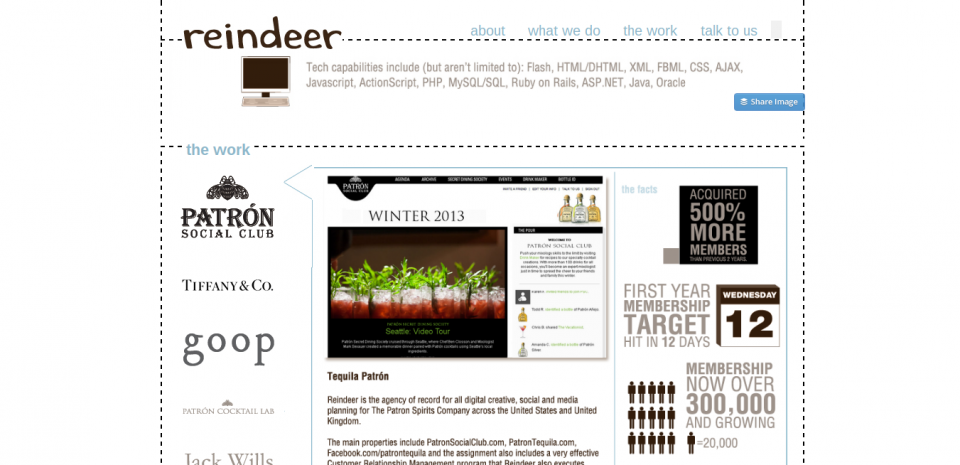
Patrón claims that Reindeer failed to respond to letters from its counsel requesting that it cease the unauthorized use of the Patrón marks, thus necessitating the filing of a complaint.

In reading the complaint, it appears that this dispute is more about Reindeer’s billings than its use of the Patrón marks.  That said, Patrón makes a claim which, if upheld by the court, could impact how advertising agencies and other service professionals reference work performed for clients for marketing purposes.  Most advertising agencies get advance permission – usually within a written service agreement – to display the work as part of the firm’s portfolio.  Some firms, however, do not seek a client’s approval.  The outcome of Patrón’s claim could bring an end to that practice.

In its complaint for trademark infringement, Patrón claims that Reindeer’s listing of it on the Reindeer website and using the Patrón marks to refer to the work performed for Patrón as having

……harmed and continues to harm Patrón.  Such use deprives Patrón of the right to control its intellectual property, and to exclude unauthorized users — the core right of such property.  Moreover, Reindeer’s use of Patrón’s marks falsely suggests a connection between the two brands, which allows Reindeer to reap the benefits of the highly valuable Patrón name and all of the associated goodwill, but without Patrón’s permission.  This unauthorized use of Patrón’s marks diminishes the exclusivity of the marks, and threatens the marks’ source-identifying significance, and this damage is exceedingly difficult to quantify in monetary terms.

The Lanham Act provides that the holder of a registered trademark can file a trademark infringement claim against any person who, without the registered trademark holder’s consent, uses any reproduction, counterfeit, copy, or colorable imitation of a registered mark, in commerce, in connection with the sale, offering for sale, distribution, or advertising of any goods or services, where such use is likely to cause confusion, or to cause mistake, or to deceive.  Pursuant to 15 U.S.C. § 1125(a), “Any person who, on or in connection with any goods or services, or any container for goods, uses in commerce any word, term, name, symbol, or device, or any combination thereof, or any false designation of origin, false or misleading description of fact, or false or misleading representation of fact, which . . .  is likely to cause confusion, or to cause mistake, or to deceive as to the affiliation, connection, or association of such person with another person, or as to the origin, sponsorship, or approval of his or her goods, services, or commercial activities by another person . . . shall be liable in a civil action by any person who believes that he or she is or is likely to be damaged by such act.”

Patrón claims that Reindeer’s conduct  “has caused and is likely to continue to cause purchasers or others to mistakenly believe that Reindeer is legitimately connected, affiliated or associated with Patrón, or that Patrón approves Reindeer’s services, which is not the case.  Consumers who encounter Reindeer’s website are likely to incorrectly believe that Reindeer currently is the exclusive provider of advertising services for Patrón.” So seemingly, Patrón has a strong claim against Reindeer…but maybe not.

Trademark law recognizes a defense where the mark is used only “to describe the goods or services of [a] party, or their geographic origin.” Courts have found that nominative trademark fair use exists where the defendant used the plaintiff’s mark simply to describe the plaintiff’s own product.  In the case of nominative trademark fair use, the original producer is deemed as a matter of law not to sponsor or endorse the third-party product or service that uses its mark in a descriptive manner.  The test for nominative trademark fair use requires the court to ask whether (1) the product was “readily identifiable” without use of the mark; (2) defendant used more of the mark than necessary; or (3) defendant falsely suggested he was sponsored or endorsed by the trademark holder.

In Volkswagenwerk Aktiengesellschaft v. Church, 411 F.2d 350, 352 (9th Cir., 1969), the Ninth Circuit applied nominative trademark fair use and found that in “advertising [the repair of Volkswagens, it] would be difficult, if not impossible, for [Church] to avoid altogether the use of the word ‘Volkswagen’ or its abbreviation ‘VW,’ which are the normal terms which, to the public at large, signify appellant’s cars.”   Church did not suggest to customers that he was part of the Volkswagen organization or that his repair shop was sponsored or authorized by VW; he merely used the words “Volkswagen” and “VW” to convey information about the types of cars he repaired.  Therefore, his use of the Volkswagen trademark was not an infringing use.

In applying nominative trademark fair use to Reindeer’s use of the Patrón marks, a court would ask whether (1) Reindeer could describe the work it performed for Patrón without using the Patrón marks; (2) in describing the past work it performed for Patrón, did Reindeer use more of the Patrón marks than necessary to convey the information; or (3) whether Reindeer’s use of the Patrón marks in describing the services it provided for Patrón falsely suggested it was sponsored or endorsed by Patrón.  In a general sense, it would be difficult, if not impossible for Reindeer, or any other service provider who provides services to Patrón, to describe the services without using the Patrón marks.  Assuming Reindeer can get past the claim that it was contractually prohibited from using the Patrón marks without Patrón’s approval, Reindeer might have a good shot at putting Patrón’s trademark claim back in the bottle.

Federal Circuit Rules the Patent Trial and Appeal Board Can Consider New Evidence During AIA Review Trial

On September 26, 2016, the U.S. Court of Appeals for the Federal Circuit declined to review in a unanimous en banc decision a panel Federal Circuit decision affirming that the Patent Trial and Appeal Board (the “Board”) at the Patent and Trademark Office (“USPTO”) could hear new evidence during a trial, evidence that was not cited by the Board in its decision to institute review under the America Invents Act (“AIA”).  In so doing, the Federal Circuit reasoned “[t]he introduction of new evidence in the course of the trial is to be expected in inter partes review trial proceedings and, as long as the opposing party is given notice of the evidence and an opportunity to respond to it, the introduction of such evidence is perfectly permissible.”

The patents at issue in the case are U.S. Patent Nos. 7,351,410 (“the ’410 patent”) and 7,655,226 (“the ’226 patent”), both entitled “Treatment of Pompe’s Disease,” and are directed to treating Pompe’s disease with injections of human acid α-glucosidase.  Pompe’s disease is a genetic disease caused by a complete or partial lack of the lysosomal enzyme acid α-glucosidase (“GAA”).  In a healthy individual, GAA breaks down glycogen, a larger molecule, into glucose.  A person with Pompe’s disease has reduced levels of GAA, or no GAA at all, and is unable to break down glycogen into glucose.  This inability results in glycogen accumulating in the muscles of affected patients in excessive amounts.  There are two forms of Pompe’s disease: early-onset and late onset.  Early onset occurs in infants shortly after birth and is usually fatal before one year because excess glycogen accumulates in the muscles and causes cardiac or respiratory failure.  Those with late onset develop the disease after infancy and have progressive muscle weakness and respiratory issues caused by the glycogen buildup in the muscles, but do not typically develop the severe cardiac symptoms associated with early onset.

In 2013, Biomarin, the petitioner, filed petitions requesting inter partes review of the ’410 and ’226 patents.  The Board granted review on two different obviousness grounds for each challenged claim in each patent.  In its final written decisions, the Board found by a preponderance of the evidence that the challenged claims of the ’410 and ’226 patents would have been obvious.  In so doing, he Board cited references in its final written decisions that were not specifically included in the combinations of prior art on which the Board instituted review.

On appeal, Genzyme, the patent owner, argued that the Board violated the requirements of notice and an opportunity to respond found in the Administrative Procedure Act (“APA”).  Genzyme argued that in finding that the claims at issue were unpatentable, the Board relied on “facts and legal arguments” that were not set forth in the institution decisions.  Therefore, according to Genzyme, it was denied notice “of the issues to be considered by the Board and an opportunity to address the facts and legal arguments on which the Board’s patentability determination [would] rest.”

The Federal Circuit rejected this argument because the Board’s decision to institute review does not need to refer to every bit of evidence that is relied on by the Board in its final written decision.  The Federal Circuit reasoned “there is no requirement, either in the Board’s regulations, in the APA, or as a matter of due process, for the institution decision to anticipate and set forth every legal or factual issue that might arise in the course of the trial.”

Moreover, the Federal Circuit found “Genzyme has not shown that the Board’s decisions rested on any factual or legal issues as to which Genzyme was denied notice or an opportunity to be heard at a meaningful point in the proceedings.”  Indeed, the Federal Circuit noted that Genzyme itself referred to the disputed prior art in its patent owner responses to the petitions.  Therefore, the Federal Circuit found “Genzyme had ample notice that the references were in play as potentially relevant evidence and that the Board might well address the parties’ arguments regarding those references in its final written decisions.”  The Federal Circuit also noted that despite having notice of the prior art, Genzyme failed to take advantage of its procedural options to seek to exclude that evidence or further respond before the Board.

Finally, the Federal Circuit also noted the relatively limited use to which the Board put the disputed references.  Specifically, the Board used the references merely to describe the state of the art; and they were not among the prior art references that the Board relied upon to establish any claim limitations.  Thus, the Federal Circuit reasoned it has previously “made clear that the Board may consider a prior art reference to show the state of the art at the time of the invention, regardless of whether that reference was cited in the Board’s institution decision.”

This case serves as a warning to both petitioners and patent owners alike when faced with patent review under the AIA.  For patent owners, do not expect to able to exclude evidence or arguments raised at trial after the fact simply because the exact contours of the evidence or arguments were not raised in the petitions or the Board decision to institute review.  Instead, take advantage of all pro-active measures along the way, such as motions to exclude, motions seeking additional briefing, and so on.  For petitioners, be careful relying too heavily on evidence or arguments not raised in the petitions or cited in the Board’s decision to institute review.  Although successful here, one could argue the results may be different if patent owner had no notice of the references, did not have any opportunity to previously object, or the references had a significant substantive role in the Board’s decision, such as to establish claim limitations.

NLRB Revises Back Pay Formula

black and white chrome clock twelve midnight

In a 3-1 ruling, the National Labor Relations Board (“Board”) recently revised its back pay formula and radically departed from its traditional remedy for compensating employees who have been unlawfully terminated. The Board’s ruling now supports employees’ rights to recover search-for-work and interim employment expenses, regardless of whether the employees have interim earnings and regardless of the amount in question.

The case involved King Soopers, Inc. who employed the complainant who was a barista at a Starbucks kiosk in a King Soopers grocery store located in Denver, Colorado. The employee had been asked by a store manager to assist with bagging groceries. She refused and questioned whether she should be doing the work, given that she belonged to a different union. The employee was suspended for five days and then terminated for gross misconduct after a meeting with store managers and her union. In its decision, the Board affirmed the finding that King Soopers violated the National Labor Relations Act (“NLRA”), which protects an employees’ right to engage in protected, concerted activity. It found that she was within her rights to question whether the work she was being assigned belonged to a different union.

Read the rest of this blog at HR USA by clicking here: 

Animation Software Patent Survives Alice Scrutiny

New idea concept. Man holding a good idea.

The application of the Supreme Court’s decision in Alice Corp. v. CLS Bank International, 134 S. Ct. 2347. (2014) has made it almost impossible to patent software.  The United States Patent and Trademark Office is increasingly rejecting patent applications for software under the Alice test on the grounds that the software is an abstract idea, and the district courts are invalidating software patents on the same grounds.  Last week, however, in McRo, Inc. v. Bandai Namco Games America Inc. (2016 U.S. App. LEXIS 16703), the Federal Circuit Court of Appeals reversed a district court’s ruling of invalidity of a software patent.

McRo owned two software patents that covered methods of automating the 3-D animation of lip synchronization to audible sounds made by the characters in animated films.  The prior art animation methods required the animator to draw the face of the character at specific points in time and then use a computer to fill in the face between the points in time.

McRo sued a number of video game developers and publishers, including Electronic Arts, Disney, Sony, and Lucasfilems for patent infringement in the Central District of California. After claim construction, the defendants filed a motion for judgment on the pleadings.  The defendants argued that McRo’s patents were invalid under 35 U.S.C. §101 as directed to patent ineligible subject matter.  The district court granted the defendants’ motion and held the claims invalid.

The district court appeared to apply the two-part test set forth in Alice, supra.  First, the court asked whether the claims were directed to an abstract idea.  The court concluded that they were not.  Instead of stopping at that point, however, as Alice requires, the district court continued its analysis, asking whether the claims were so broad as to preempt the field.  The court concluded that the claims were preemptively broad, and entered judgment of invalidity against McRo.

McRo appealed to the Federal Circuit.  On appeal, McRo argued that the claims were not directed to an abstract idea, but instead were directed to a technological process, the automation of lip synchronization of a 3-D animated character.  McRo contended that the claims did not preempt the field because there were other methods of automated lip synchronization in animation.

The defendants argued that the claims were invalid because they were directed to mathematical algorithms, a type of abstract idea.  In addition, the defendants argued that McRo’s claims preempted the field because they covered the use of any set of rules to animate lip synchronization.

The Federal Circuit reversed the district court’s ruling.  The court reiterated the two-part Alice test for determining whether claims are directed to patent ineligible subject matter.  Under 35 U.S.C. section 101, “any new and useful process, machine, manufacture, or composition of matter” is patentable.  The courts have established three exceptions to patentable subject matter:  laws of nature, natural phenomena, and abstract ideas.

Under the Alice test for patentable subject matter, the first step is to decide whether the claims are directed to one of the exceptions, such as abstract ideas.  If the answer is no, the inquiry ends and the subject matter is patent eligible.  If the answer is yes, the second step is to decide whether the claims contain an inventive concept, an element or combination of elements that take the claim into patent eligible subject matter.  The courts have interpretted the second step to mean that the claims cannot preempt the field; they cannot monopolize “the basic tools of scientific and technological work.”  Alice, supra, 134 S. Ct. at 2354.

The Federal Circuit emphasized that the district courts should be careful not to oversimplify the claims of a patent.  The court found that McRo’s claims covered the use of certain types of rules, but not all rules, that could be used to automate the animation of lip synchronization.  There were other ways for animators to automate lip synchronization, and McRo’s claims did not preempt all types of rules.  Thus, McRo’s claims were not directed to patent ineligible subject matter, and, therefore, there no further inquiry was required under Alice.  Because the district court had erred in applying the second step of the Alice test, the Federal Circuit reversed, holding the claims valid.

Is the Technology for Self-Driving Cars Patent-Eligible?

It sounds like a silly question, doesn’t it?  After all, self-driving cars represent innovative progress in technology, and patents are intended “to promote the progress of science and useful arts, by securing for limited times to authors and inventors the exclusive right to their respective writings and discoveries.”  U.S. Constitution, Article I, Section 8, Clause 8.

But not so fast — courts have found that many software-based inventions for automating known techniques are patent ineligible under 35 U.S.C. §101 (“§101”).  The reasoning is that these inventions merely represent abstract ideas, which are not patentable.  In fact, even when software was combined with standard hardware, such as computers, displays, cameras, and sensors, many courts have found that the inventions did not involve patent-eligible subject matter.  While this article does not focus on any particular patent, one could argue that certain aspects of self-driving cars are just attempts to automate, largely with the use of software and well-known hardware, what humans have been doing for over 100 years — driving cars while trying to avoid accidents.  Does that mean such patents would be rejected by the United States Patent and Trademark Office (“USPTO”) or invalidated by a court?

To analyze this issue in more detail, first we should consider the technology that many automobile and technology companies, such as Tesla, Volvo, Toyota, and Google, are developing to enable commercially viable, self-driving vehicles.  In fact, some of this technology is already on the road, and numerous patents have already been issued in the field.  The technology is based on the use of various combinations of sensors, cameras, computers, and software.  For example, radar sensors are used to detect the position of nearby vehicles.  Lidar, which uses lasers and sensors, can be used to measure the distance to objects, build a 3D map, and detect hazards, such as the edges of roads and lane markings.  Video cameras are used to detect obstacles such as pedestrians and other vehicles, as well as traffic lights and road signs.  Ultrasonic sensors in the wheels can be used to monitor car movements and detect curbs and other vehicles, such as for use in automatic parking.  But the heart of the system, which most would say is the most complex aspect, is the software that analyzes the data from all of the sensors and controls the car’s systems (e.g., steering, braking, and acceleration) to maneuver it safely.

What have courts said about the patentability of such software-based inventions?  In Alice Corp. v. CLS Bank, the U.S. Supreme Court looked at the patentability of certain claims under §101 by applying the two-step test it had set forth in Mayo v. Prometheus.  In applying the two-step test, first, a court should determine whether the claims are directed to an abstract idea.  If they are, the second step is to determine whether the claims include elements showing an inventive concept that transforms the idea into a patent-eligible invention.  While the Court in Alice stated it was treading carefully in invalidating the claims at issue and warned that applying the decision too broadly could “swallow all of patent law,” numerous patents have been invalidated by district courts in light of the decision in Alice.

At this point, the line between abstract idea and patentable invention has been blurred to the point that it is often difficult to determine whether an invention is patentable.  For example, the court in The Chamberlain Group LLC v. Linear LLC refused to invalidate claims for a monitoring and alarm system related to network communication between a controller and a movable barrier, such as a garage door.   As part of its reasoning, the court noted the claims were “not directed to a method for organizing human activity or computerizing a long-standing commercial practice.”  In contrast, other courts have found the use of computers, memory, transmitters, receivers, and networks not sufficient to save patent claims.  For example, the court in White Knuckle Gaming v. Electronic Arts invalidated claims on an Internet-based method for updating software because it was an abstract idea and performed on a conventional computer, server, and network.  In Visual Memory v. NVIDIA, the court found that categorical data storage was an abstract idea, stating it was a well-known technique performed by humans.  The court in Kinglite Holdings v. MicroStar invalidated a BIOS multitasking patent, stating that it was basically a process for doing two things nearly simultaneously and humans do that all the time.

This means that when asserting your patent in litigation, you will likely face a motion to dismiss on the pleadings or an early summary judgment motion if your patent is vulnerable to a §101 challenge.  In response, it will be necessary to 1) determine whether claim construction is necessary prior to a ruling, 2) argue what distinguishes your patent from an abstract idea, and 3) explain why your patent involves a sufficiently inventive concept that will transform an abstract idea into a patent-eligible invention under step two of the Mayo/Alice test.

In the case of software and sensors for self-driving cars, the system may be performing a task that humans often perform, but it is probably not doing it in the same manner that humans do.  There is a substantial difference between merely writing software to balance a checkbook using substantially the same steps a human would use and designing software that can drive a car.  That is because a human could not write down the steps or analysis techniques that one goes through to safely drive and navigate a car in all situations.  In fact, researchers have long been trying to understand how humans process images and signals received from the environment.  Therefore, one can argue that a self-driving car is not merely an automated implementation of the steps performed by a human.  Instead, a different approach and different algorithms suitable for computer implementation have been developed to accomplish the goal of driving.  We will have to wait to see if that distinction and argument will prevail.

The question has arisen whether courts can resolve the ambiguities and confusion of patentability under §101, or whether it is time for legislative action.  Some argue that the Federal Circuit and Supreme Court should give the district courts the guidance and clarification they need to predictably determine what is patent-eligible under §101.  David Kappos, former director of the USPTO, suggested the solution is to abolish §101.  Others suggest that amendment of §101 would be sufficient.  Until the issue is resolved, additional care must be taken when drafting patents to limit vulnerability to §101 challenges.

How BREXIT Will Affect Intellectual Property

As everyone knows, in June, the United Kingdom passed the BREXIT referendum (driven by British voters), voting to exit the European Union.  What affect does BREXIT have on intellectual property rights in the United Kingdom and the European Union?  There is a two-year process of negotiation between the UK and the EU, provided for by law, to determine the specifics of the exit.  Until that process is completed, the UK remains an EU Member State.  There will be no immediate change in intellectual property rights, but, once the exit has been accomplished, certain intellectual property rights will be affected.

PATENTS

        European patents will not be affected by BREXIT.  The UK was and will continue to be a member of the European Patent Convention and the Patent Cooperation Treaty.  The EPC is not connected to the EU; it is a separate treaty among European nations, and the UK is a member nation.  The PCT is also not connected to the EU; it is an international treaty among countries worldwide, and the UK is a member state.  UK and non-UK patent applicants can continue to file their applications in the European Patent Office and designate the UK, so that they can obtain patents in the UK through the current EPO validation system.

However, BREXIT will significantly impact the EU’s new Unitary Patent and Unified Patent Court.  This new system provides for a single (unitary) patent in the EU and a separate court to enforce those patents.  The Unified Patent Court will handle only patent matters, including infringement and validity, and will have locations throughout Europe.  The court will have the authority to issue injunctions against infringers covering all of the EU, and can revoke patents throughout the EU.

BREXIT will delay implementation of the new Unitary Patent and Unified Patent Court system, which is set to go into effect in 2017.  The system is the subject of an EU initiative and agreement, which the UK and certain other countries must ratify.  It is unclear whether the UK will now ratify the agreement.  If the UK does not, the other EU members will have to amend the agreement or start over and draft a new agreement.

Even if the Unitary Patent and Unified Patent Court are implemented, however, the UK will not be participating, as the system is limited to members of the EU.  It is possible that the UK and the EU will negotiate a resolution to this issue by which the system moves forward, but that is unclear at this point.

TRADEMARKS

Of all of the types of intellectual property, European Union Trade Marks (“EUTMs”) will be the most affected by BREXIT.  The EUTM is a trademark that is valid and can be enforced in all member states of the EU.  Once the UK is out of the EU, the EUTM will have no effect in the UK.

The UK may adopt regulations that allow an EUTM to be automatically registered in the UK, maintaining the mark’s priority.  However, because trademark rights are based on use of the mark, the owners who want protection in the UK will have to show use of the mark in the UK, and those who want protection in the EU will have to show use in the EU.

EU trademark owners should consider where their marks are being used and will be used in the future, and plan to obtain trademark registration in both the EU and UK if necessary.  Because of this, it is expected that the UK Intellectual Property Office will be faced with a large increase in trademark applications, resulting in delays in registrations.

In addition, BREXIT will cause the enforcement of trademark rights to become significantly more complicated and costly.  Injunctions currently in place for EUTM owners will not be valid in the UK.  Owners will need to file new infringement actions in the UK courts to obtain new injunctions against infringers previously covered by an EU injunction.  In the future, trademark owners will need to file two infringement actions if their mark is registered in both the UK and the EU, one action in each court system.

Lastly, EUTM owners may face challenges to their EUTMs if their sole use was in the UK.  After the UK exits, these marks could be cancelled, revoked, or not renewed if they have not been used in the EU.

COPYRIGHTS

Copyrights will probably not be affected directly by BREXIT as copyright law in Europe is governed by the laws of each country.  The UK has its own copyright laws and is also a member of various international treaties protecting copyright.  Thus, rights of copyright owners in the UK will continue to be protected under both sets of laws.

One area that will likely be affected by BREXIT are laws governing internet service providers and information stored in the cloud.  The EU has been developing this area of law for the last several years.  At this point, however, it is uncertain whether the UK will have its own set of laws separate from the EU’s laws.

TRADE SECRETS

The EU has been working on a uniform trade secrets law, which will define trade secrets and provide uniform remedies.  If the EU adopts the law, the UK may be required to also adopt it depending on the method by which the exit is accomplished.  Again, it is uncertain how this will be resolved.

LICENSES

Licenses may be affected by BREXIT, depending on their terms.  Licensors and licensees should review existing licenses to determine whether the defined territory covers both the EU and the UK and whether the dispute resolution procedures will be applicable to the appropriate territory.  The parties may need to enter into amendments or new licenses to clarify their rights.

NO ICE, PLEASE!

Coffee cup on grey background (seen from above) with clipping path

California’s unfair competition and consumer protection laws protect consumers from false representations about products or services.  These laws include the Unfair Competition Law (Business and Professions Code §17200, et seq.), the False Advertising Law (Business and Professions Code §17500, et seq.), and the Consumer Legal Remedies Act (Civil Code §1750).  Lawsuits for violation of the consumer protection laws are often brought as class actions on behalf of the general public.  Such actions are important because, in many cases, there is no other practical way for an individual to obtain redress for a wrong that affects the public.

Sometimes, however, cases are filed under the unfair competition and consumer protection laws that are intended to correct real problems, but are simply attempts to make money.  One of the best examples is a case filed against Starbucks for deceiving consumers by underfilling its iced drinks.  The underfilling is allegedly due to the presence of ice in the drink.  As ridiculous as it sounds, that was the plaintiff’s claim.  A federal district judge in the Central District of California found the case to be just that – ridiculous – and dismissed it two and a half months after it was filed.

The plaintiff, Alexander Forouzesh, filed his complaint in Los Angeles County Superior Court on June 1, 2016.  Forouzesh alleged that Starbucks advertises its cold drinks by fluid ounce: a Tall is 12 oz., a Grande is 16 oz., a Venti is 24 oz., and a Trenta is 30 oz.  The plaintiff alleged that Starbucks intentionally filled its clear plastic cold drink cups with less than the advertised amount of liquid, and then added ice to fill up the cup.  The plaintiff apparently purchased some Starbucks drinks, removed the ice, and measured the volume of liquid in the cup.  Naturally, he found that the volume of liquid was less than the size of the cup.  He found that a Venti contained 14 oz. of fluid beverage, not 24 oz. as advertised.  So, for example, if you order a Venti iced tea (as I have many times), you get about 14 oz. of tea and the rest of the 24-oz. cup is filled with ice.  The plaintiff alleged that because ice is not a liquid, Starbucks misrepresents its drink sizes.  He claimed that he and the class would not have purchased Starbucks’ drinks had they known that the actual amount of liquid in the cup was less than the volume of the cup, or, at least, would not have paid as much money as Starbucks charged for the drinks.

The complaint asserts claims for violation of the Unfair Competition Law, False Advertising Law, Consumer Legal Remedies Act, breach of express warranty, breach of implied warranty, fraud, negligent misrepresentation, and unjust enrichment.

Starbucks removed the case to the Central District of California and filed a motion to dismiss.  In its motion, Starbucks argued that all of the plaintiff’s claims failed the plausibility standard because no reasonable consumer would be misled by Starbucks’ drink sizes.  Any reasonable consumer would know that a 24-oz. cup of iced tea or iced coffee does not contain 24 oz. of liquid because consumers expect the cup to contain ice (which will take up some of the space in the cup), they can see the ice in the clear plastic cup, and they ordered an iced drink.  As Starbucks emphasized, how can consumers be deceived when they order an “iced” drink and it arrives with the named ingredient, ice, in it?

Judge Percy Anderson wasted no time in ruling for Starbucks.  Starbucks’ reply brief was filed on August 9, 2016, and the court vacated the oral agreement shortly thereafter, taking the matter under submission (perhaps the court enjoyed an iced drink while reviewing the motion!).  On August 19, 2016, the court issued its decision granting Starbucks’ motion, dismissing the case with prejudice, and entering judgment for Starbucks.

The court stated that:

“. . . [Y]oung children learn they can increase the amount of beverage they receive if they order ‘no ice.’  If children have figured out that including ice in a cold beverage decreases the amount of liquid they will receive, the Court has no difficulty concluding that a reasonable consumer would not be deceived into thinking that when the order an ice tea, that the drink they receive will include both ice and tea and that for a given size cup, some portion of the drink will be ice rather than whatever liquid beverage the consumer ordered.”

The court relied on the fact that Starbucks’ cups are clear and consumers can see the ice in the cups.  The court also found that Starbucks did not actually state that its drinks had specific amounts of liquid, but only that the drinks were of certain sizes.  According to the court, a reasonable consumer “knows the size of the cup that drink will be served in and that a portion of the drink will consist of ice.  Because no reasonable consumer could be confused by this, plaintiff fails to state viable . . . claims.”  Sounds logical.

Interestingly, Starbucks faces a similar class action lawsuit over its hot drinks.  In that case, Strumlauf v. Starbucks Corporation (N.D. California), the plaintiff alleged that Starbucks underfilled its hot drinks because of the foam and because it uses standardized fill lines in the hot drink cups that are less than the listed size of the drinks.  Recently, the court in that case granted Starbucks’ motion to dismiss in part, dismissing certain claims, but denied the motion as to the plaintiff’s claims for breach of express warranty, fraud, and violation of the Unfair Competition Law, False Advertising Law, and Consumer Legal Remedies Act.  The court found that the plaintiff had stated facts sufficient to support claims that consumers were likely to be deceived with Starbucks’ hot drink sizes.  Thus, Starbucks has had more difficulty getting rid of this case at the pleading stage than the iced drink case, possibly because the hot drinks are not served in clear cups and do not contain the word “foam” in the name of the drink.

In both cases, Starbucks has emphasized that any customer not satisfied with their drink can ask that it be remade.  That might be a better solution than the court awarding millions of dollars in damages to Starbucks’ customers!

Federal Circuit Holds the PTAB Must Apply Narrower Phillips Claim Construction Standard to Patents that Expire During Pendency of Re-exam

Pillars and Brick Wall

In In re CSB-System Int’l, Inc., No. 15-1832 (Fed. Cir. Aug. 9, 2016), the Court of Appeals for the Federal Circuit recently held that patents that expire during a pending re-examination before the Patent Trial and Appeal Board (“PTAB”) should be examined under the Phillips standard of claim  construction, and not the broadest reasonable interpretation (“BRI”) standard.  Typically, in District Court litigation claims in issued patents are construed using the framework set forth in Phillips v. AWH Corp., which considers the plain meaning of the claim terms themselves in light of the intrinsic record.  However, during re-examination proceedings for unexpired patents, the PTAB uses the BRI standard.  The reason for using the broader BRI standard in re-examinations is that a patent owner before the Patent and Trademark Office (“PTO”) with an unexpired patent may amend the claims to narrow their scope, thus negating any unfairness that may otherwise result from adopting the broader BRI standard.

To read this blog and the rest of our Intellectual Property blogs, click here: http://www.theiplawblog.com/2016/08/articles/patent-law/federal-circuit-holds-the-ptab-must-apply-narrower-phillips-claim-construction-standard-to-patents-that-expire-during-pendency-of-re-exam/

The Seattle Seahawks’ 12th Man Flies Again

If you regularly follow our publication, you may remember when I discussed the Seattle Seahawks and their use of the Texas A&M trademark “12TH MAN” over a year ago. If not, that’s okay too. In short, I discussed how the Seattle Seahawks have been utilizing the Texas A&M trademark without permission and were facing legal action for infringement when the parties entered into their first licensing agreement in 2006 for $100,000 upfront and an additional $5,000 per year. This deal was subsequently renewed in 2011. I ended my previous article by acknowledging that the agreement was coming to an end and that there was likely to be a new, more lucrative deal in place due to the mark’s popularity among Seahawks fans.

Sure enough, the deal that the Seahawks and Texas A&M reached is more lucrative than the previous deal. The Seahawks have agreed to pay $140,000 to Texas A&M upfront, plus $18,000 per year as a royalty fee for using the mark in the Pacific Northwest, an additional $10,000 per year to assist Texas A&M with its efforts to protect its trademark from would be infringers, and an undisclosed yearly fee, through 2021. Moreover, Texas A&M has also narrowed the scope of the license that it is granting to the Seattle Seahawks. Although the Seahawks have never utilized “12th Man” on their merchandise, they will no longer use the mark on the Ring of Honor or the team’s social media handles. Overall, this is favorable deal for Texas A&M, which will receive more money for a more restrictive license to the Seahawks.

Interestingly, I suspect the Seahawks do not have an issue with the narrowly tailored license in light of their recent conduct. Over the past few seasons, the Seahawks have shifted away from their use of “12TH MAN” in favor of “12” and “12s,” both of which the Seahawks have registered with the United States Patent and Trademark Office. The Seahawks own several “12” related trademarks, including without limitation, “WE ARE 12s,” “THE 12s,” “THE SPIRIT OF 12,” and “12.” So, it seems that although the Seahawks still obviously value their use of the “12TH MAN” mark, they are slowly distancing themselves from the mark and creating their own set of 12 marks, which I would not be surprised to see displace their use of the “12TH MAN” entirely by 2021. Of course, only time will tell.

Small Burger Chain Has a Beef With Chipotle

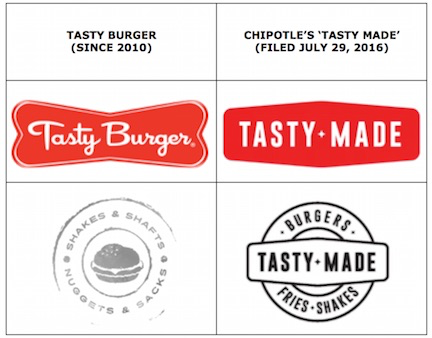
Chipotle’s entry into the burger business has a Boston based small burger chain up in arms.  The Boston burger spot, which has been in operation since 2010 and goes by the name Tasty Burger, has a beef with the brand Chipotle has chosen for its restaurants, Tasty Made.

Tasty Burger claims that Chipotle brand infringes on its trademark,  Despite a cease and desist letter and public threats of a lawsuit, Chipotle has publicly stated that it “fully intend(s) to move forward with the name Tasty Made for our burger restaurant and strongly believe that we are on solid footing in doing so.”

Why might Chipotle feel – or claim to feel – so secure in its brand choice.  Tasty Burger has superior common law rights; it has been using its mark since July 2010.  Additionally, Tasty Burger applied for a Federal trademark registration in December 2010 and was granted federal registration for its trademark in 2012.  On first blush, it seems that Tasty Burger has a strong case.  However, things may not be as they seem.

During the registration process for Tasty Burger’s trademark, the United States Patent and Trademark Office refused to register the trademark for Tasty Burger on the Principal Register because it is merely descriptive.  A mark is merely descriptive if it describes an ingredient, quality, characteristic, function, feature, purpose or use of the specified goods and/or services.  The trademark examiner assigned to the Tasty Burger application argued as follows:

In the present case, applicant is using the mark TASTY BURGER, stylized, and design, in connection with “Restaurant services.”   As indicated in the initial Office action, the wording TASTY BURGER describes good tasting hamburgers, an item presumably offered in applicant’s restaurants.  See the definitions enclosed with the initial Office action.

In addition, the applied-for mark shows the wording in stylized lettering.  However, the degree of stylization in this case is not sufficiently striking, unique or distinctive so as to create a commercial impression separate and apart from the unregistrable components of the mark.  See In re Sambado & Son Inc., 45 USPQ2d 1312 (TTAB 1997); In re Bonni Keller Collections Ltd., 6 USPQ2d 1224 (TTAB 1987). Furthermore, the design consists of a common geometric shape and merely functions as a background carrier for the word portion of the proposed mark.  Accordingly, the entire mark must be deemed to be merely descriptive.

In response to the refusal to register, Tasty Burger abandoned its request for registration on the Principal Register and sought registration on the USPTO’s Supplemental Register.  Marks that do not meet the Principal Register’s requirement of being inherently distinctive but that otherwise meet the technical requirements for registration are registrable on the Supplemental Register.  The benefits and protections for marks registered on the Supplemental Register do not compare to those granted to marks registered on the Principal Register.  Registration on the Principal Register is prima facie evidence of the mark owner’s exclusive right to use the mark nationwide in connection with the goods or services set forth in the registration.  The Supplemental Registration provides no such benefits; the owner of a mark registered on the Supplemental Register must rely on common law rights and must also prove that their mark actually functions as a trademark.

So is Tasty Burger’s claim cooked?  Maybe not.  Merely descriptive trademarks may become protectable through “acquired distinctiveness” or “secondary meaning.”  These are legal concepts by which a term that is descriptive may, through use, has become distinctive of the owner’s goods or services.  One of the ways a mark owner may establish secondary meaning is by showing exclusive and continuous use in commerce for the five years.

Tasty Burger has been using its mark since 2010.  As such, it will be able to establish a prima facie case that its mark is distinctive.  This in and of itself does not mean that Tasty Burger will be able to establish likelihood of confusion; a mark can be distinctive and still be highly suggestive and entitled to little protection.  In order to establish greater protection, Tasty Burger must introduce other evidence of acquired distinctiveness such as declarations from its customers, its advertising and promotional activities and market research and consumer reaction studies.

Tasty Burger will have a strong position to argue that the Chipotle Tasty Made burger chain will infringe its common law rights in its Boston and Washington, DC locations.  Tasty Burger can take certain immediate actions that may increase its strength and leverage but whether Tasty Burger will prevent Chipotle from opening Tasty Made throughout the rest of the US remains to be seen.