

Welcome to the Weintraub Tobin Resources Page

Browse below for news, legal insights, information on presentations and events, and other resources from the Weintraub Tobin legal team.


18 Weintraub Tobin Attorneys Named to Sacramento Magazine’s Top Lawyers List 2016

SACRAMENTO, California – July 25, 2016 – Weintraub Tobin Law Corporation congratulates its 18 attorneys who have been included in Sacramento magazine’s 2016 Top Lawyer List.

David C. Adams | Business/Corporate, Mergers & Acquisitions
Brendan Begley | Appellate
Taylor W.Bentley | Securities & Corporate Finance
Gary L. Bradus | Banking & Financial Service, Business/Corporate
Kay U. Brooks | Estate Planning & Probate
Dale C. Campbell | Business Litigation
Christopher Chediak | Business/Corporate, Commercial Law, Mergers & Acquisitions, Securities & Corporate Finance
Janet Z. Chediak | Estate Planning & Probate, Real Estate
Jim Clarke | Tax
Edward J. Corey, Jr. | Estate Planning & Probate
Louis A. Gonzalez, Jr. | Business Litigation, Litigation: Commercial, Real Estate
James Kachmar | General Litigation
Shawn Kent | Real Estate
Michael Kvarme | Mergers & Acquisitions, Real Estate
Darrin M. Menezes | Alternate Dispute Resolution
Audrey A. Millemann | Intellectual Property, Litigation: Intellectual Property
Charles L. Post | General Litigation
Lizbeth V. West | Employment & Labor

About Sacramento’s Top Lawyers List 2016

Voting for Professional Research Services’ survey to determine the top attorneys in 2016 for Sacramento magazine was open to all licensed attorneys in Sacramento, California. Attorneys were asked whom they would recommend among 53 legal specialties, other than themselves, in the Sacramento area. Each attorney was allowed to recommend up to three colleagues in each given legal specialty. Once the online nominations were complete, each nominee was carefully evaluated on the basis of the survey results, the legitimacy of their license, and their current standing with The State Bar of California. Attorneys who received the highest number of votes in each specialty are reflected in the above list.

The professionals listed above were selected by their peers in a survey conducted by Professional Research Services Company of Royal Oak, Michigan. Professionals may be screened and selected through the verification of licensing and review of any infractions through various applicable boards, agencies, and rating services. For further information, visit prscom.com or email PRS at asamhat@hour-media.com

About Weintraub Tobin Chediak Coleman Grodin Law Corporation

With offices in Los Angeles, Newport Beach, Sacramento, San Diego, and San Francisco, Weintraub Tobin is an innovative provider of sophisticated legal services to dynamic businesses and business owners, as well as non-profits and individuals with litigation and business needs. For more information on the firm, visit weintraub.com.
INDUCED INFRINGEMENT BECOMES MORE DIFFICULT TO DEFEND

In Warsaw Orthopedic, Inc. v. NuVasive, Inc. (June 3, 2016) 2016 U.S. App. LEXIS 10092, the Federal Circuit Court of Appeals broadly interpreted the Supreme Court’s test for induced infringement, finding irrelevant the defendant’s belief that there was no infringement.

Warsaw and a related company, Medtronic, sued NuVasive for patent infringement.  NuVasive counterclaimed against Warsaw and Medtronic for infringement of its patent.  NuVasive’s patent covered methods used during surgery to detect a nerve and determine the distance to the nerve.  NuVasive alleged that Medtronic manufactured a device that surgeons used to directly infringe the method claims of NuVasive’s patent, and that Medtronic induced the surgeons’ infringement.  Medtronic contended that it had not induced infringement because it had a reasonable belief, under Medtronic’s narrow construction of the claims, that the device did not perform the claimed method.

The case was tried in the district court for the Southern District of California.  The court instructed the jury on the requirements for proving induced infringement, under 35 U.S.C. section 271(b), as set forth by the Supreme Court in Global-Tech Appliances, Inc. v. SEB S.A., 563 U.S. 754 (2011). Under Global-Tech, induced infringement requires proof that the defendant knew of the plaintiff’s patent and knew that the acts it induced were infringing.  Global-Tech also held that a plaintiff can prove the defendant’s knowledge that the induced acts were infringing by proof of the defendant’s willful blindness, which can be proved by circumstantial evidence.

At trial, the jury found that Medtronic had induced infringement of NuVasive’s patent by instructing the surgeons on the use of Medtronic’s device.  On appeal, the Federal Circuit affirmed the jury’s verdict.  The Supreme Court then decided Commil USA, LLC v. Cisco Systems, Inc., 191 L. Ed. 2d 883 (2015), which confirmed the Global-Tech test for induced infringement.

Medtronic filed a petition for certiorari in the Supreme Court, seeking an order vacating the Federal Circuit’s decision and remanding the case for further consideration under Commil.  In particular, Medtronic argued that NuVasive had not proved that Medtronic knew that the surgeons’ acts it induced were infringing.

The Supreme Court granted certiorari and remanded the case to the Federal Circuit.  On remand, the sole question before the Federal Circuit was whether NuVasive had produced substantial evidence that Medtronic knew, or was willfully blind to the fact, that the surgeons using their device infringed NuVasive’s patent.  Medtronic argued that it did not believe its device infringed the patent and that this belief negated the specific intent required for a finding of knowledge.

The Federal Circuit disagreed and affirmed its original decision.  The court held that Medtronic’s belief was objectively unreasonable, and that there was substantial evidence that Medtronic knew (or was willfully blind to the fact) that the surgeons infringed NuVasive’s patent.  In a concurring opinion, however, one of the judges pointed out that the majority based its conclusion solely on the evidence of direct infringement (that the surgeons’ use of the device performed the claimed method), not on any evidence of Medtronic’s knowledge or willful blindness.

This case appears to be a warning – if you think you may be inducing infringement of a patent, relying on your “reasonable” belief that there is no underlying direct infringement is a bad idea!

Fee Limits Ruled Unlawful in Florida Workers’ Comp Cases

In a long-awaited decision, the Florida Supreme Court ruled in Marvin Castellanos v. Next Door Company, et al. that the limitations on attorneys’ fees awarded under Florida’s workers’ Compensation statute violates the due process clause of both the Florida and United States Constitutions. As a result of this holding, attorneys are no longer limited to fees based exclusively on a percentage of the benefits actually secured.  They may now be awarded an hourly fee for time and effort reasonably expended on litigating workers’ compensation benefits.

To read the full blog, please visit:  http://blog.hrusa.com/blog/fee-limits-ruled-unlawful-in-florida-workers-comp-cases/ 

Darrell White Appointed American Bar Association, Litigation Section Liaison to the Commission on Hispanic Legal Rights and Responsibilities

Weintraub congratulates Darrell White in our Newport Beach office on his appointment to serve as the American Bar Association, Litigation Section Liaison to the Commission on Hispanic Legal Rights and Responsibilities. The Commission was created in 2010 to address the challenges and responsibilities facing Hispanics in and within the legal system of the United States. The ABA is one of the world’s largest voluntary professional organizations, with nearly 400,000 members and more than 3,500 entities. For more information on the Commission please click here.

Darrell is an associate at Weintraub Tobin, specializing in commercial litigation. Darrell has represented companies both small and large, from real estate to financial services industries, on complex litigation matters. He recently obtained dismissal of a regulatory action where Plaintiff sought $67.5 million from a national outdoor sporting goods company. Outside of the office, Darrell is an active Board Member with the Orange County Hispanic Bar Association where he currently serves as CFO.

Neutral Services: We Help You Connect The Pieces

The Labor & Employment attorneys at Weintraub Tobin can help you avoid expensive and protracted litigation. We specialize in:

  • Training supervisors on various workplace issues, including preventing harassment, discrimination, and retaliation; workplace health and safety; and managing leave laws.
  • Conducting independent investigations into complaints of misconduct in the workplace.
  • Mediating employment disputes both pre and post litigation

For more information please contact:

Lizbeth “Beth” West 916.558.6082 or lwest@weintraub.com

Vida L. Thomas 916.558.6058 or vthomas@weintraub.com

Meagan D. Bainbridge 916.558.6038 or mbainbridge@weintraub.com

Employee Requests For Payroll Records: Haste Makes, er, a Hash of Things

Conventional wisdom notwithstanding, employers are people or, if they are not, they are staffed by people. People often take short cuts. HR workers are no different from anybody else.  They are prone to take the shortest distance between two points.  It may be for that reason that I am increasingly seeing employers make a common error in responding to employee requests for “payroll records”. Labor Code section 226, among other things, requires an employer who receives a written or oral request (from a current or former employee) to inspect or copy records to comply with the request “as soon as practicable,” but no later than 21 calendar days of the request.

Let me back up a second; Labor Code section 226 requires employers to produce to employees at the time of payment of wages, a statement that contains nine specific categories of information, including the “legal” name of the employer (more on that in another blog); a description of deductions and all time worked, wages earned and paid, and all hourly rates of pay.  Failure to comply with this section can cause an employer no end of grief.

The same section requires employers to retain a copy of wage statements and a record of deductions for at least three years. In my experience not a lot of employers retain hard copies of wage statements. As an alternative to hard copy or “.pdf” storage, section 226 permits employers to produce a computer generated record that accurately shows all of the required information. Fairly read, this section requires employers to produce duplicates of wage statements provided to employees.  Even if that is not what is intended by this section, it is fair to say that many employees and their attorneys expect employers who receive a request for payroll records under Labor Code section 226 to produce a duplicate wage statement that contains all nine categories of information required by this section.

Yet, when responding to such a demand, many employers produce “payroll inquiries,” payroll summary documents or screen shots of electronic payroll system data, rather than produce a duplicate wage statement or summary that contains all of the information required by section 226.  This can be a costly and time consuming mistake.  Employers have been known to spend tens of thousands of dollars trying fix that mistake.  When an employer produces a “payroll inquiry” or other summary of wages (rather than the wage statement required by section 226), the attorney for the worker will examine the record produced in response to that demand for sufficiency under section 226.  If it fails that examination because of missing information (employer identity, hourly rates, etc.), the employer then has to explain why, when asked for “payroll records” it produced something other than the wage statement required by section 226.

I know, this is unfair.  But here is the take away as I see it: When asked by an employee (or an attorney for an employee) to produce wage statements issued to the worker pursuant to Labor Code section 226 or “payroll records required to be maintained pursuant to Labor Code section 226,” either provide duplicates of the wage statements provided to the employee or a computer generated record that contains all of the information required by Labor Code section 226.

As I say above, failure to do this, can be an expensive mistake to fix.

33 Weintraub Tobin Attorneys Named Among 2016 Super Lawyers and Rising Stars

Super Lawyers has released its Northern California, Southern California, and San Diego lists of outstanding attorneys for 2016, on which 33 Weintraub Tobin attorneys have been included. Three Weintraub Tobin attorneys received special honors in their respective regions.

Weintraub Tobin attorneys named to the 2016 Southern California and San Diego Super Lawyers include David R. Gabor in the firm’s Los Angeles office; Gary A. Waldron in the firm’s Newport Beach office; and Jo Dale Carothers, Ph.D., in the firm’s San Diego Office.

Attorneys listed as 2016 Northern California Super Lawyers include Brendan J. Begley, Gary L. Bradus, Kay U. Brooks, Dale C. Campbell, Christopher Chediak, Janet Z. Chediak, Jim Clarke, Edward J. Corey, Jr., Kelly E. Dankbar, Louis A. Gonzalez, Jr., James KachmarShawn M. Kent, Michael A. Kvarme, Audrey A. Millemann, Charles L. Post, and Lizbeth V. West in the firm’s Sacramento office; and Paul E. Gaspari and Hilary L. Lamar in the firm’s San Francisco office.

Weintraub Tobin attorneys named to the 2016 Southern California and San Diego Rising Stars – those who are either 40 years of age or younger, or have been practicing for 10 years or less – include Jessica Marlow in the firm’s Los Angeles office; Jacob C. Gonzales and Darrell P. White in the firm’s Newport Beach office; and Eric Caligiuri in the firm’s San Diego office.

Attorneys listed as 2016 Northern California Rising Stars include Taylor W. Bentley, Lukas Clary, Mark E. EllinghouseDaniel C. Kim, and Melissa M. Whitehead in the firm’s Sacramento office; Shauna N. Correia, and Jeffrey Pietsch in the firm’s San Francisco office.

Special Super Lawyers distinctions went to:

Edward J. Corey Jr. 

  • Top 25: 2016 Sacramento Super Lawyers
  • Top 100: 2016 Northern California Super Lawyers

Charles L. Post

  • Top 25: 2016 Sacramento Super Lawyers
  • Top 100: Northern California Super Lawyers
  • Top 10: 2016 Northern California Super Lawyers

Lizbeth V. West

  • Top 50: 2016 Women Northern California Super Lawyers
  • Top 25: 2016 Sacramento Super Lawyers
  • Top 100: 2016 Northern California Super Lawyers

About Super Lawyers

Super Lawyers is a rating service of outstanding lawyers from more than 70 practice areas who have attained a high degree of peer recognition and professional achievement. The annual selections are made using a patented multiphase process that includes a statewide survey of lawyers, an independent research evaluation of candidates, and peer reviews by practice area. The result is a credible, comprehensive, and diverse listing of exceptional attorneys. The Super Lawyers lists are published nationwide in Super Lawyers Magazine and in leading city and regional magazines and newspapers across the country.

About Weintraub | Tobin
With offices in Los Angeles, Newport Beach, Sacramento, San Diego, and San Francisco, Weintraub Tobin is an innovative provider of sophisticated legal services to dynamic businesses and business owners, as well as non-profits and individuals with litigation and business needs. For more information on the firm, visit weintraubstage.wpengine.com.

En Banc Federal Circuit Rules A Product Must be the Subject of a Commercial Sale or Offer for Sale to Trigger On-Sale Bar

On July 11, 2016, the U.S. Court of Appeals for the Federal Circuit ruled in a unanimous en banc decision in The Medicines Co. v. Hospira Inc., Federal Circuit case number 2014-1469, that to be “on sale” under pre-AIA 35 U.S.C. § 102(b), a product must be the subject of a commercial sale or offer for sale, and that a commercial sale is one that bears the general hallmarks of a sale pursuant to Section 2-106 of the Uniform Commercial Code.   If the product is “on sale” more than one year before the filing of an application for a patent, any issued patent is invalid and patent protection is lost.  The issue before the Court in Medicines Co. was whether a product is “on sale” under 35 U.S.C. § 102(b) when the product is produced by a third-party contract manufacturer.

The two patents at issue, U.S. Patent Nos. 7,582,727 (“the ’727 patent”) and 7,598,343 (“the ’343 patent”), are FDA Orange Book listed as covering Angiomax, which is the trade name of a form of bivalirudin.  Bivalirudin is a synthetic peptide comprised of twenty amino acid residues. Bivalirudin drug products are used to prevent blood from clotting and are regarded as highly effective anticoagulants for use during coronary surgery.  However, the bivalirudin active pharmaceutical ingredient is too acidic for human injection without further processing.  Thus, the patented compounding process produces Angiomax by creating a bivalirudin solution and then adjusting the solution’s pH with a base while controlling the creation of impurities.  The ’727 patent and ’343 patent contain product and product-by-process claims for pharmaceutical batches of the improved bivalirudin drug product.

Critically, plaintiff Medicines Co. (“MedCo”) did not sell Angiomax to the public before filing for the patents, but instead used a third-party contract manufacturing organization, Ben Venue Laboratories (“Ben Venue”), to ensure the drug met U.S. Food and Drug Administration requirements.  Thus, the Federal Circuit’s opinion touched on an important issue in the patenting of pharmaceuticals and other products, such as semiconductors: the use of contract manufacturers and the manufacturing processes necessary to produce these products.

The dispute at issue here traces back to August 2010, when MedCo sued Hospira in the United States District Court for the District of Delaware, alleging that two of Hospira’s ANDA filings infringed certain claims of the ’727 patent the ’343 patent.  After a three-day bench trial in September 2013, the district court found the patents not invalid and not infringed.  In considering invalidity, the court had to determine whether the invention was sold or offered for sale before the critical date under § 102(b), i.e. was it subject to the on-sale bar.

Applying the two-step framework of Pfaff v. Wells Electronics, Inc., 525 U.S. 55 (1998), the district court found that the three batches Ben Venue manufactured for MedCo did not trigger the on-sale bar.  Pfaff’s two-step framework requires that the claimed invention was (1) the subject of a commercial offer for sale; and (2) ready for patenting.  The district court concluded that the first prong of Pfaff was not met because the claimed invention was not commercially offered for sale prior to the critical date.  The court reasoned that the transactions between MedCo and Ben Venue were sales of contract manufacturing services in which title to Angiomax always resided with MedCo.  The court also found that because the batches were for FDA “validation purposes,” the batches were not made for commercial profit, but were for experimental purposes, thus avoiding the on-sale bar.

On appeal, a panel of the Federal Circuit reversed the district court’s ruling regarding the applicability of the on-sale bar, finding MedCo “commercially exploited” the invention before the critical date, even if it did not transfer title to Angiomax.  The panel also found the experimental use exemption did not apply because the invention had already been reduced to practice, so MedCo could not have been experimenting.  At the request of MedCo, the Federal Circuit vacated the panel’s ruling to consider the case en banc.

Applying § 102(b) in light of Pfaff, the Federal Circuit en banc concluded that the transactions between MedCo and Ben Venue did not constitute a commercial sale of the patented product.  The full Court affirmed the district court’s conclusion that those transactions were not invalidating under § 102(b), and reversed the panel’s determination.  The Court reasoned that the sale of manufacturing services by a contract manufacturer to an inventor to create embodiments of a patented product for the inventor does not constitute a “commercial sale” of the invention.  MedCo did not market or release its invention by contracting with Ben Venue, but only paid the company to make batches of the drug because it did not have the manufacturing capabilities to do it in-house.  The Court saw no reason to treat MedCo differently than a company with in-house manufacturing capabilities.  “There is no room in the statute and no principled reason…to apply a different set of on-sale bar rules…depending on whether [a company] outsources manufacturing or manufactures in-house.”  Instead, the focus of the on-sale bar analysis should be on what makes a sale “commercial” in “the most well-understood sense of that term…as distinct from merely obtaining some commercial benefit from a transaction.”

More broadly, the Court explained that a commercial benefit alone is not enough to trigger the on-sale bar of § 102(b); the transaction must be one in which the product is “on sale” in the sense that it is “commercially marketed.”  As a general proposition, the Court instructed that one should look to the Uniform Commercial Code (“UCC”) to define whether a communication or series of communications rises to the level of a commercial offer for sale.  However, the Court also cautioned that while “[t]he UCC has been recognized as the general law governing the sale of goods, [it] is another useful, though not authoritative, source in determining the ordinary commercial meaning of” terms used by the parties.

Given that the en banc Federal Circuit had found that there was no commercial sale of the inventions in the ’727 and ’343 patents, the Court declined to reach a ruling on the experimental use finding.  However, the Court did make clear that the panel’s statement that there can be no experimental use after a reduction to practice is inaccurate.  Finally, the Court addressed the issue of “stockpiling” by an inventor and clarified that “stockpiling” by the purchaser of manufacturing services is not improper commercialization under § 102(b).

Both the panel and en banc Federal Circuit only considered whether the patents were invalid under the on-sale bar, and did not consider other issues related to claim construction, infringement, and invalidity on other grounds.  Thus, the case has been remanded back to the original Federal Circuit panel for further proceedings on these issues and is still far from over.

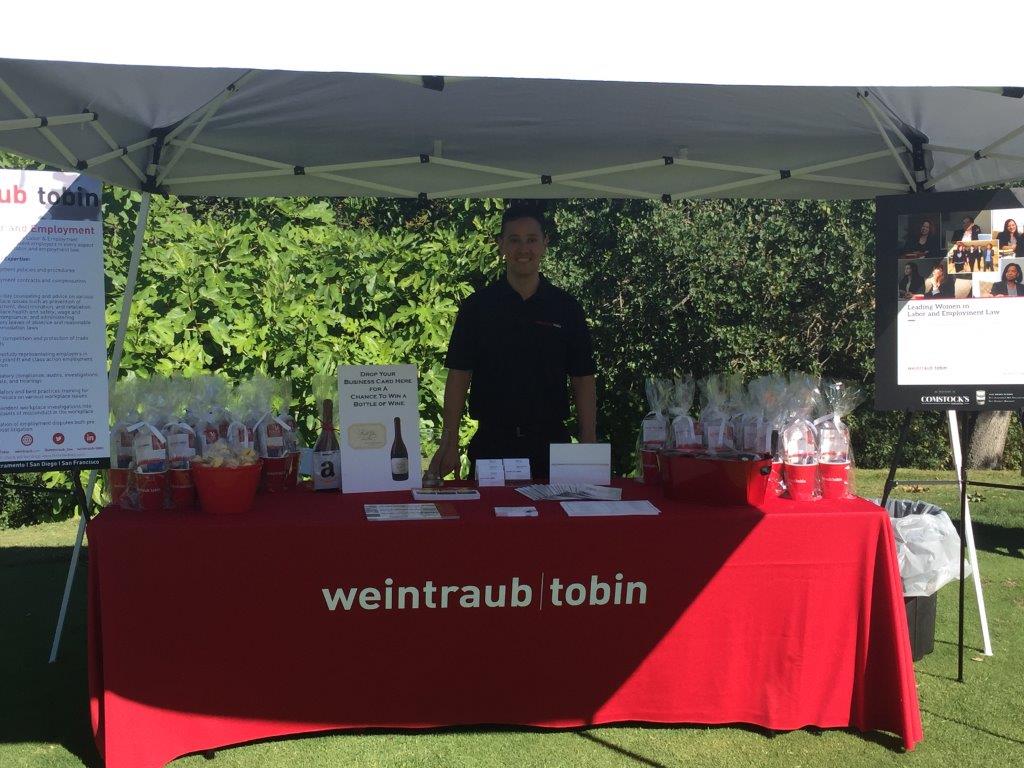
Weintraub Tobin is proud to have sponsored the 36th Annual California Restaurant Association – Sacramento Chapter’s “Rock N’ Roll” Golf Tournament

Weintraub Tobin is proud to have sponsored the 36th Annual California Restaurant Association – Sacramento Chapter’s “Rock N’ Roll” Golf Tournament on July 11th at the Granite Bay Country Club. A number of Weintraub’s Labor & Employment attorneys spent the day with a great group of golfers on the third hole as they all tried their best to take home the prize for the “closest to the hole” prize. Thanks to Weintraub attorney, Lukas Clary, for all his hard work on this fun and important event. Weintraub Tobin looks forward to its continued partnership with the California Restaurant Association.