Welcome to the Weintraub Tobin Resources Page

Browse below for news, legal insights, information on presentations and events, and other resources from the Weintraub Tobin legal team.


Chris Chediak named 2017 ‘Lawyer of the Year’ for Corporate Law in Sacramento

Sacramento, California – Weintraub Tobin Chediak Coleman Grodin, a business law and litigation firm, announces that Chris Chediak has been named Lawyer of the Year in Corporate Law for 2017 in Sacramento by Best Lawyers in America®. After more than a quarter of a century in publication, Best Lawyers is designating “Lawyers of the Year” in high-profile legal specialties in large legal communities. Individuals are named to the list based on their particularly high level of peer recognition.

Chris is a senior shareholder in the firm’s Corporate group, and is a leading corporate transactional attorney in the region.  Chris’ practice focuses on governance, mergers and acquisitions, corporate finance, fiduciary matters, and other entity transactions, including early and late stage financing, reorganizations, strategic partnering, joint ventures, licensing, distribution, and researching arrangements. He has extensive experience representing both public and private clients and regularly represents clients in the following industries: agri-business, technology, software, private equity, venture capital, manufacturing and non-profit associations.

Chris was also named 2009 & 2014 “Lawyer of the Year” by Best Lawyers.

Since it was first published in 1983, Best Lawyers has become universally regarded as the definitive guide to legal excellence. Because Best Lawyers is based on an exhaustive peer-review survey in which more than 36,000 leading attorneys cast almost 4.4 million votes on the legal abilities of other lawyers in their practice areas, and because lawyers are not required or allowed to pay a fee to be listed, inclusion in Best Lawyers is considered a singular honor. Corporate Counsel magazine has called Best Lawyers “the most respected referral list of attorneys in practice.”


OSHA’s Fact Sheet Providing Guidance to Employers To Protect Workers from Exposure to the Zika Virus

OSHA’s Fact Sheet providing guidance for protecting workers from occupational exposure to the Zika virus explains that the Zika virus is primarily spread through the bites of infected mosquitoes and that mosquitoes can become infected when they bite infected persons and then spread the Zika virus to other persons they subsequently bite. According to OSHA, current science-based evidence suggests that approximately one out of five infected people develops symptoms of the Zika virus, usually beginning 2-7 days after the bite of an infected mosquito. The most common symptoms of the Zika virus infection are fever, rash, joint pain, and red or pink eyes. Other symptoms can include myalgia (muscle pain) and headache. More serous neurological and autoimmune complications are possible but have not been seen in the U.S.

There is no vaccine to prevent the Zika virus and there is no specific treatment for individuals who become infected. Although the Zika virus is generally spread by the bites of infected mosquitoes, exposure to an infected person’s blood or other body fluids (e.g. through sexual transmission) may also result in transmission. Employers should train workers about their risks of exposure to the Zika virus through various modes of transmission.Beth-West-15_web

OSHA points out that employees who work outside may be at the greatest risk of exposure to the Zika virus. Some workers, including those working with insecticides to control mosquitoes and healthcare workers who may be exposed to contaminated blood or other potentially infectious materials from individuals infected with the Zika virus, may require additional protections (e.g., certain types of personal protective equipment, PPE).

OSHA provides the following recommendations to employers who have employees that work outside:

  • Check the CDC Zika website to find Zika-affected areas.
  • Inform employees about their risks of exposure to Zika virus through mosquito bites and train them how to protect themselves.
  • Provide insect repellents and encourage their use.
  • Provide employees with, and encourage them to wear, clothing that covers their hands, arms, legs, and other exposed skin. Consider providing employees with hats with mosquito netting to protect the face and neck.
  • In warm weather, encourage employees to wear lightweight, loose-fitting clothing. This type of clothing protects employees against the sun’s harmful rays and provides a barrier to mosquitoes.
  • Always provide employees with adequate water, rest and shade, and monitor them for signs and symptoms of heat illness.
  • Get rid of sources of standing water (e.g., tires, buckets, cans, bottles, barrels) whenever possible to reduce or eliminate mosquito breeding areas. Train employees about the importance of eliminating areas where mosquitos can breed at the worksite.
  • If requested by an employee, consider reassigning anyone who indicates she is or may become pregnant, or who is male and has a sexual partner who is or may become pregnant, to indoor tasks to reduce their risk of mosquito bites.

OSHA explains that its guidance is not a standard or regulation, and it creates no new legal obligations. It contains recommendations as well as descriptions of mandatory safety and health standards. The recommendations are advisory in nature, informational in content, and are intended to assist employers in providing a safe and healthful workplace. To obtain a copy of the Fact Sheet, go to https://www.osha.gov/sites/default/files/publications/OSHA3855.pdf

The EEOC’s Final Rules On Employer Wellness Programs

The U.S. Equal Employment Opportunity Commission (“EEOC”) recently issued two final rules confirming that employers can offer limited incentives (in the form of a reward or avoidance of a penalty) to encourage employees and their spouses to participate in workplace wellness programs.  Under these new rules, employers who offer wellness programs will be allowed to provide such limited incentives to employees or their spouses to induce them to provide information about their current or past health status.  The new rules modify regulations that pertain to Genetic Information Nondiscrimination Act (“GINA”) while creating new regulations that pertain to the Americans with Disabilities Act (“ADA”).

To read the rest of the blog, click here:

The Life Span of the Employment Relationship: Hiring, Disciplining and Firing

  • When: Sep 15, 2016
  • Where: Weintraub Tobin Office
Empty desk after termination of employment – landscape interior.

Summary of Program
The Labor and Employment Group at Weintraub Tobin is pleased to offer this informative seminar that will discuss recent cases to help business owners, human resource professionals, and managers avoid liability and effectively hire employees as well as carry out disciplines and terminations. This seminar will cover:

• Lawful and effective job postings and interview questions.
• Tips for an effective and meaningful discipline process.
• Effective policies, training and documentation to reduce liability.
• “Progressive Discipline” – Beware!
• Conduct that may constitute “retaliation” and the laws that apply.
• Properly responding to “whistleblowers”.
• Voluntary quits versus “constructive” termination.
• What constitutes “wrongful termination” and what that means for at-will employment.

Date:  September 15, 2016
Time:  9:30 a.m. – 11:30 a.m.

Seminar
9:00 am – 9:30 am – Registration & Breakfast
9:30 am – 11:30am – Seminar

Webinar: This seminar is also available via webinar. Please indicate in your RSVP if you will be attending via webinar.

Location
Weintraub Tobin Office
400 Capitol Mall, 11th Floor | Sacramento, CA 95814

Parking Validation provided. Please park in the Wells Fargo parking garage, entrances on 4th and 5th Street. Please bring your parking ticket with you to the 11th floor.

Approved for two (2) hours MCLE. This program will be submitted to the HR Certification Institute for review. Certificates will be provided upon verification of attendance for the entirety of the webcast.

There is cost for this seminar.

*This seminar will be limited to 75 in-person attendees.

The Seattle Seahawks’ 12th Man Flies Again

If you regularly follow our publication, you may remember when I discussed the Seattle Seahawks and their use of the Texas A&M trademark “12TH MAN” over a year ago. If not, that’s okay too. In short, I discussed how the Seattle Seahawks have been utilizing the Texas A&M trademark without permission and were facing legal action for infringement when the parties entered into their first licensing agreement in 2006 for $100,000 upfront and an additional $5,000 per year. This deal was subsequently renewed in 2011. I ended my previous article by acknowledging that the agreement was coming to an end and that there was likely to be a new, more lucrative deal in place due to the mark’s popularity among Seahawks fans.

Sure enough, the deal that the Seahawks and Texas A&M reached is more lucrative than the previous deal. The Seahawks have agreed to pay $140,000 to Texas A&M upfront, plus $18,000 per year as a royalty fee for using the mark in the Pacific Northwest, an additional $10,000 per year to assist Texas A&M with its efforts to protect its trademark from would be infringers, and an undisclosed yearly fee, through 2021. Moreover, Texas A&M has also narrowed the scope of the license that it is granting to the Seattle Seahawks. Although the Seahawks have never utilized “12th Man” on their merchandise, they will no longer use the mark on the Ring of Honor or the team’s social media handles. Overall, this is favorable deal for Texas A&M, which will receive more money for a more restrictive license to the Seahawks.

Interestingly, I suspect the Seahawks do not have an issue with the narrowly tailored license in light of their recent conduct. Over the past few seasons, the Seahawks have shifted away from their use of “12TH MAN” in favor of “12” and “12s,” both of which the Seahawks have registered with the United States Patent and Trademark Office. The Seahawks own several “12” related trademarks, including without limitation, “WE ARE 12s,” “THE 12s,” “THE SPIRIT OF 12,” and “12.” So, it seems that although the Seahawks still obviously value their use of the “12TH MAN” mark, they are slowly distancing themselves from the mark and creating their own set of 12 marks, which I would not be surprised to see displace their use of the “12TH MAN” entirely by 2021. Of course, only time will tell.

NLRB Panel’s Strict Interpretation Of “You’re Fired”

On July 14, 2016, a three-member panel appointed by the National Labor Relations Board (“NLRB”) reversed an Administrative Law Judge decision in favor of the employee. The Panel found that a complaining employee who was told he was “fired” in a meeting and subsequently told he was not fired after the meeting on the same day, was in fact discharged for purposes of the Act. Thus, the Panel found the employer violated National Labor Relations Act (the “Act”) Section 8(a)(1).

Read more about it here: https://www.nlrb.gov/

EEOC Urges Employers To Revamp Harassment Prevention Practices

Female office worker making shocked expression over man’s hands on her knee.

On June 20, 2016, the Co-Chairs of the EEOC’s Select Task Force on the Study of Harassment in the Workplace issued a 130-page report detailing its findings after 14 months of study of workplace harassment. To the dismay of many employers, the Select Task Force found that workplace harassment remains a persistent problem, and most employers’ harassment prevention training has been ineffective in preventing it.  The Select Task Force urged employers to “reboot” their workplace harassment prevention efforts.

Read about it here: https://www.eeoc.gov/select-task-force-study-harassment-workplace

Nine Weintraub Tobin Attorneys Named to Best Lawyers In America© 2017

SACRAMENTO, California – August 15, 2016 – Weintraub Tobin congratulates its nine partners who have been included in The Best Lawyers of America© 2017 list.

David Adams, Sacramento, Corporate Governance Law & Leveraged Buyouts and Private Equity Law

Dale Campbell, Sacramento, Bet-The-Company Litigation, Commercial Litigation
Chris Chediak, Sacramento, Corporate Law
Jim Clarke, Sacramento, Tax Law & Litigation and Controversy – Tax
Daniel B. Eng, San Francisco, Banking & Finance Law, Corporate Governance Law, Securities/Capital Market & Leveraged Buyouts and Private Equity Law
Louis Gonzalez, Jr., Sacramento, Litigation – Real Estate
Michael A. Kvarme, Sacramento, Real Estate Law
Charles L. Post, Sacramento, Employment Law Management & Litigation – Labor and Employment
Gary D. Rothstein, San Francisco, Litigation-Trusts and Estates

For more information on Best Lawyers In America© 2017, visit: https://www.bestlawyers.com/

Small Burger Chain Has a Beef With Chipotle

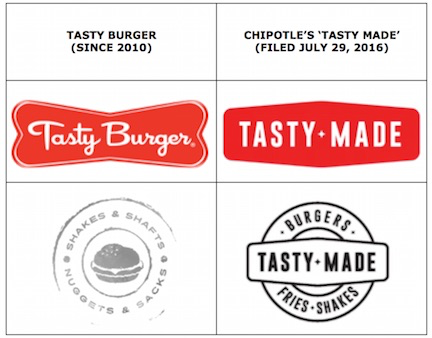
Chipotle’s entry into the burger business has a Boston based small burger chain up in arms.  The Boston burger spot, which has been in operation since 2010 and goes by the name Tasty Burger, has a beef with the brand Chipotle has chosen for its restaurants, Tasty Made.

Tasty Burger claims that Chipotle brand infringes on its trademark,  Despite a cease and desist letter and public threats of a lawsuit, Chipotle has publicly stated that it “fully intend(s) to move forward with the name Tasty Made for our burger restaurant and strongly believe that we are on solid footing in doing so.”

Why might Chipotle feel – or claim to feel – so secure in its brand choice.  Tasty Burger has superior common law rights; it has been using its mark since July 2010.  Additionally, Tasty Burger applied for a Federal trademark registration in December 2010 and was granted federal registration for its trademark in 2012.  On first blush, it seems that Tasty Burger has a strong case.  However, things may not be as they seem.

During the registration process for Tasty Burger’s trademark, the United States Patent and Trademark Office refused to register the trademark for Tasty Burger on the Principal Register because it is merely descriptive.  A mark is merely descriptive if it describes an ingredient, quality, characteristic, function, feature, purpose or use of the specified goods and/or services.  The trademark examiner assigned to the Tasty Burger application argued as follows:

In the present case, applicant is using the mark TASTY BURGER, stylized, and design, in connection with “Restaurant services.”   As indicated in the initial Office action, the wording TASTY BURGER describes good tasting hamburgers, an item presumably offered in applicant’s restaurants.  See the definitions enclosed with the initial Office action.

In addition, the applied-for mark shows the wording in stylized lettering.  However, the degree of stylization in this case is not sufficiently striking, unique or distinctive so as to create a commercial impression separate and apart from the unregistrable components of the mark.  See In re Sambado & Son Inc., 45 USPQ2d 1312 (TTAB 1997); In re Bonni Keller Collections Ltd., 6 USPQ2d 1224 (TTAB 1987). Furthermore, the design consists of a common geometric shape and merely functions as a background carrier for the word portion of the proposed mark.  Accordingly, the entire mark must be deemed to be merely descriptive.

In response to the refusal to register, Tasty Burger abandoned its request for registration on the Principal Register and sought registration on the USPTO’s Supplemental Register.  Marks that do not meet the Principal Register’s requirement of being inherently distinctive but that otherwise meet the technical requirements for registration are registrable on the Supplemental Register.  The benefits and protections for marks registered on the Supplemental Register do not compare to those granted to marks registered on the Principal Register.  Registration on the Principal Register is prima facie evidence of the mark owner’s exclusive right to use the mark nationwide in connection with the goods or services set forth in the registration.  The Supplemental Registration provides no such benefits; the owner of a mark registered on the Supplemental Register must rely on common law rights and must also prove that their mark actually functions as a trademark.

So is Tasty Burger’s claim cooked?  Maybe not.  Merely descriptive trademarks may become protectable through “acquired distinctiveness” or “secondary meaning.”  These are legal concepts by which a term that is descriptive may, through use, has become distinctive of the owner’s goods or services.  One of the ways a mark owner may establish secondary meaning is by showing exclusive and continuous use in commerce for the five years.

Tasty Burger has been using its mark since 2010.  As such, it will be able to establish a prima facie case that its mark is distinctive.  This in and of itself does not mean that Tasty Burger will be able to establish likelihood of confusion; a mark can be distinctive and still be highly suggestive and entitled to little protection.  In order to establish greater protection, Tasty Burger must introduce other evidence of acquired distinctiveness such as declarations from its customers, its advertising and promotional activities and market research and consumer reaction studies.

Tasty Burger will have a strong position to argue that the Chipotle Tasty Made burger chain will infringe its common law rights in its Boston and Washington, DC locations.  Tasty Burger can take certain immediate actions that may increase its strength and leverage but whether Tasty Burger will prevent Chipotle from opening Tasty Made throughout the rest of the US remains to be seen.

Trucking Company Found In Violation Of WARN Act

Often times, when a company acquires another company, it does not wish to retain all of the other company’s employees.  The employees who do not get brought on board often end up out of work.  Under these circumstances, issues arise over how to handle the laid off employees.  Federal law requires employers to provide at least 60-days’ written notice prior to terminating employees affected by such a merger.  So who is required to provide the notice, the employees’ current employer or the new company that does not wish to retain them? Under federal law, if the employees remain employed as of the day of the sale, the purchasing company assumes responsibility for providing the required notice.  According to the 8th Circuit, this remains true even where the purchasing company never intended to employ the laid off workers and expressly contracted away the notice obligation when completing the purchase agreement.

Read more about it here: http://blog.hrusa.com/blog/trucking-company-found-in-violation-of-warn-act/