^ WP_User {#17185
  +data: {#17186
    +"ID": "6"
    +"user_login": "Msiceloff"
    +"user_pass": "$P$BVg0DDH.AOcuasVwoTguJCoGHjNlJt1"
    +"user_nicename": "msiceloff"
    +"user_email": "msiceloff@weintraub.com"
    +"user_url": ""
    +"user_registered": "2022-06-21 15:33:28"
    +"user_activation_key": ""
    +"user_status": "0"
    +"display_name": "Mary Siceloff"
  }
  +ID: 6
  +caps: array:1 [
    "administrator" => true
  ]
  +cap_key: "wp_capabilities"
  +roles: array:1 [
    0 => "administrator"
  ]
  +allcaps: array:70 [
    "switch_themes" => true
    "edit_themes" => true
    "activate_plugins" => true
    "edit_plugins" => true
    "edit_users" => true
    "edit_files" => true
    "manage_options" => true
    "moderate_comments" => true
    "manage_categories" => true
    "manage_links" => true
    "upload_files" => true
    "import" => true
    "unfiltered_html" => true
    "edit_posts" => true
    "edit_others_posts" => true
    "edit_published_posts" => true
    "publish_posts" => true
    "edit_pages" => true
    "read" => true
    "level_10" => true
    "level_9" => true
    "level_8" => true
    "level_7" => true
    "level_6" => true
    "level_5" => true
    "level_4" => true
    "level_3" => true
    "level_2" => true
    "level_1" => true
    "level_0" => true
    "edit_others_pages" => true
    "edit_published_pages" => true
    "publish_pages" => true
    "delete_pages" => true
    "delete_others_pages" => true
    "delete_published_pages" => true
    "delete_posts" => true
    "delete_others_posts" => true
    "delete_published_posts" => true
    "delete_private_posts" => true
    "edit_private_posts" => true
    "read_private_posts" => true
    "delete_private_pages" => true
    "edit_private_pages" => true
    "read_private_pages" => true
    "delete_users" => true
    "create_users" => true
    "unfiltered_upload" => true
    "edit_dashboard" => true
    "update_plugins" => true
    "delete_plugins" => true
    "install_plugins" => true
    "update_themes" => true
    "install_themes" => true
    "update_core" => true
    "list_users" => true
    "remove_users" => true
    "promote_users" => true
    "edit_theme_options" => true
    "delete_themes" => true
    "export" => true
    "wf2fa_activate_2fa_self" => true
    "wf2fa_activate_2fa_others" => true
    "wf2fa_manage_settings" => true
    "copy_posts" => true
    "wpseo_manage_options" => true
    "manage_postman_smtp" => true
    "manage_postman_logs" => true
    "wpseo_manage_redirects" => true
    "administrator" => true
  ]
  +filter: null
  -site_id: 1
}
Mary Siceloff, Author at Weintraub Tobin - Page 78 of 179

Welcome to the Weintraub Tobin Resources Page

Browse below for news, legal insights, information on presentations and events, and other resources from the Weintraub Tobin legal team.


Copyright Infringement and Third Party Software Support

A recent case out of the Ninth Circuit, Oracle USA, Inc. v. Rimini Street, Inc. (July 13, 2017), illustrates some of the risks third party software vendors run concerning copyright issues.  Oracle develops and licenses proprietary “enterprise software” for business around the world.  A business using Oracle’s enterprise software would pay a one-time licensing fee to download the software and then can elect to buy a license maintenance contract that provides for periodic software updates.

Rimini provides third party support for Oracle’s enterprise software in lawful competition with Oracle’s own maintenance services. In the course of providing third party services, Rimini also is required to provide software updates to its customers.  It appears that between 2006 and 2007, Rimini obtained software and/or updates from Oracle’s website with automated downloading tools on behalf of several of its customers.

Oracle sued Rimini in 2010 and obtained partial summary judgment on parts of its copyright infringement claim.  After trial, the jury found in favor of Oracle on other claims (including computer abuse claims which are not discussed in this article) and awarded Oracle damages that totaled more than $120 million after interest, attorney’s fees and costs were added.  Rimini appealed the Court’s decision to the Ninth Circuit.

One of the primary issues addressed by the Ninth Circuit was whether Rimini copied Oracle software in a manner that gave rise to copyright infringement.  The evidence was undisputed that Rimini used Oracle’s enterprise software to help develop and test updates that it would then push out to its customers.  It appears that Rimini, while using the license for one of its customers to obtain the Oracle download, would then use the software to provide updates to other customers who either had Oracle licenses or were considering obtaining them.

Rimini argued that it should have prevailed on the copyright infringement claims by asserting two affirmative defenses, express license and copyright misuse.  As to the express license defense, the U.S. Supreme Court has long recognized that “anyone who is authorized by the copyright owner to use the copyrighted work in a way specified in the statute … is not an infringer of the copyright with respect to such use.”  However, a person could be liable for copyright infringement to the extent they exceed the scope of the license granted by the copyright holder.  Thus, the Ninth Circuit’s inquiry focused on whether Rimini was acting in excess of the scope of the licenses held by its customers.

The District Court had instructed the jury that it would not necessarily be copyright infringement by Rimini if it had used a customer’s license to develop updates for that particular customer.  However, it would be unlawful if Rimini was to use the license from one particular customer to develop updates to be used by others. The Ninth Circuit reasoned that Rimini’s use of one customer’s license to develop updates for other of its customers amounted to “cross use” and rejected Rimini’s claims that “cross use” is not infringement.  The Court found it significant that Rimini acknowledged that “cross use“ allows it to reduce expense to its customers by essentially “reusing work” performed for one customer.  The Ninth Circuit rejected this argument and agreed with Oracle by focusing on the language of the licenses that limited the scope of any authorized use to be done on behalf of that particular licensee.  By performing work for other customers, Rimini was exceeding the scope of any license and therefore was liable for copyright infringement.

Next, the Ninth Circuit turned to Rimini’s claim that Oracle was guilty of “copyright misuse.”  The copyright misuse doctrine prohibits copyright holders “from leveraging their limited monopoly to allow them control of areas outside the monopoly.”  In essence, the doctrine is intended to prevent copyright holders from stifling competition; however, it is not intended to prohibit the copyright holder from using conditions “to control use of copyrighted material.”  As a result, the copyright misuse defense should only be used “sparingly.”

Rimini argued that in essence, Oracle was “misusing” its copyright to prevent competition in the “aftermarket for third party maintenance.”  The Ninth Circuit rejected this argument finding that there was nothing wrong with requiring third party maintenance vendors to respect and comply with Oracle’s copyrights.

The Ninth Circuit’s decision in Oracle is a reminder that third party software vendors relying on their customer’s licensing of software or other computer programs need to be careful of running afoul of copyright laws.  Such vendors should obtain legal advice as to whether any of their proposed services run afoul of the software owners’/developers’ copyright interests.

Neutral Services: Workplace Investigations

The Labor & Employment attorneys at Weintraub Tobin specialize in conducting independent investigations into complaints of misconduct in the workplace. At Weintraub Tobin, we take pride in the top-notch investigations conducted by our experienced group of attorney-investigators.  Our attorneys have conducted hundreds of investigations for private companies, for-profit companies, non-profit companies, cities, counties, and state agencies, school districts, community college districts, and other special districts. For more information, please visit our Workplace Investigations page here.

You Aren’t In Kansas Anymore, Dorothy: A Common Sense Method of Complying with California’s New Fair Pay Act

  • When: Feb 15, 2018
Wooden court gavel and a plaque that reads equal pay.

Summary of Program

For decades the California Equal Pay Act has prohibited an employer from paying its employees less than employees of the opposite sex for equal work. On October 6, 2015, Governor Brown signed the California Fair Pay Act (SB 358), which strengthened the Equal Pay Act in a number of ways.  Then, on September 30, 2016, Governor Brown signed two other bills into law – SB 1063 which added race and ethnicity as protected categories under the Fair Pay Act, and AB 1676 – which prohibits employers from justifying a sex-, race-, or ethnicity-based pay differences solely on the grounds of prior salary.  California’s Fair Pay Act is now known as one of the strictest in the nation.Join Weintraub Tobin’s labor and employment attorneys as they discuss California’s Fair Pay Act and what this means for employers.

Program Highlights

  • The amendments to the Fair Pay Act
  • Recordkeeping requirements
  • What is “substantially similar work”
  • Justifications for pay difference
  • Bona fide factors other than sex, race, or ethnicity
  • How to comply with the Act
  • Strategies to defend against litigation

Date & Time:

February 15, 2018

9:30 a.m. – 11:30 a.m.

Seminar Program

9:00 a.m. – 9:30 a.m. – Registration & Breakfast

9:30 a.m. – 11:30 a.m. – Seminar

Location

Weintraub Tobin Office

400 Capitol Mall, 11th Floor | Sacramento, CA 95814

Parking Validation provided. Please park in the Wells Fargo parking garage, entrances on 4th and 5th Street. Please bring your ticket with you to the 11th floor for validation.

There is no charge for this seminar.

Webinar

This seminar is also available via webinar. Please indicate in your RSVP if you will be attending via webinar.

Approved for two (2) hours MCLE.  This program will be submitted to the HR Certification Institute for review.  Certificates will be provided upon verification of attendance for the entirety of the webcast. 

Neutral Services: Training

The Labor & Employment attorneys at Weintraub Tobin specialize in training supervisors on various workplace issues, including preventing harassment, discrimination, and retaliation; workplace health and safety; and managing leave laws.  For more information, please visit our Trainings page here

U.S. District Court for the Central District of California Makes Rare FRAND Royalty Rate Determination

The U.S. District Court for the Central District of California recently issued its opinion in TCL Communications v. Ericsson (SACV 14-341 JVS(DFMx) and CV 15-2370 JVS (DFMx)) on standard-essential patents and whether a commit to license them was on terms that are fair, reasonable and nondiscriminatory, or FRAND.  The Court determined Ericsson did not offer to license its standard essential patents on reasonable terms, and instead become only the fourth U.S. Court to determine a royalty rate for essential patents.

Patent holders that own patents essential to industry standards often offer (or are required by the standard setting body to offer) to license their patents on FRAND terms when a patent is, or may become, essential to practice a technical standard, such as the wireless communications standards.  A patent becomes standard-essential when a standard-setting organization sets a standard that adopts the patented technology.  The acceptance of a patent holder’s patent into a standard is of great value to the patent holder, and enhances the monopoly which the patent holder has by virtue of the patent.  The accepted patents are often referred to as standard essential patents, or “SEPs.”  Anyone who wishes to manufacture products or provide services in accordance with the standard must now secure a license from the patent holder.  However, in exchange for acceptance of the patent as part of a standard, the patent holder must agree to license that technology on FRAND terms, which is typically a lower license rate than a standard (or non-FRAND) patent license in a comparable setting and with little ability to refuse to license.

Here, this case focused on the licensing of patents in the telecommunications field affecting 2G, 3G, and 4G1 cellular technologies.  Potential licensees TCL Communication Technology Holdings, Ltd. TCT Mobile Limited, and TCT Mobile (US) Inc. ( collectively “TCL”) manufacture and distribute cell phones on a world-wide scale.  Patent holders Telefonaktiebolaget LM Ericsson and Ericsson Inc. ( collectively “Ericsson”) hold an extensive portfolio of telecommunications patents.  TCL sought to license Ericsson’s patents, but the parties could not agree on terms.  The relevant standard setting organization at issue in this dispute is the European Telecommunications Standards Institute, or “ETSI.”

In beginning its analysis, the Court laid out the three tasks it needed to undertake.  The Court had to first “determine whether Ericsson met its FRAND obligation, and then whether Ericsson’s final offers before litigation, Offer A and Offer B, satisfy FRAND.  If they are not, the Court must determine what terms are material to a FRAND license, and then supply the FRAND terms.”

There were two principal schemes presented to the Court to consider in determining the proper FRAND rate, and if Ericcson offered to license at that FRAND rate.  One approach, offered by TCL, is a “top-down” approach which begins with an aggregate royalty for all patents encompassed in a standard, then determines a firm’s portion of that aggregate.  There other, offered by Ericcson, is an “ex ante,” or ex-Standard, approach which seeks to measure in absolute terms the value which Ericsson’s patents add to a product.  However, instead of just using one approach or another, the Court combined the two approaches.  Essentially, the Court undertook a non-discrimination analysis based principally on the review of comparable licenses.

At the end of the day, after conducting its analysis based on the combined hybrid non-discrimination approach, the Court reached the following conclusions:  “Ericsson negotiated in good faith and its conduct during the course of negotiations did not violate its FRAND obligation.  It is unnecessary for the Court to determine whether the failure to arrive at an agreed FRAND rate violated Ericsson’s FRAND obligation. Regardless of the answer to that question, the Court is required to assess whether FRAND rates have been offered in light of the declaratory relief which both sides seek.”

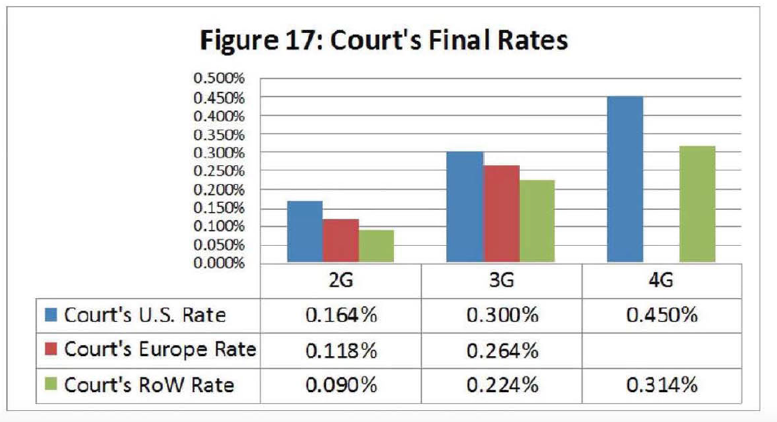
The Court then determined that Ericsson’s Offer A and Offer B were not FRAND rates and proceed to determine its own FRAND rates.  The court prescribed that the parties enter into a 5-year license agreement reflecting the FRAND rates, and TCL must pay Ericsson approximately $16.5 million for past unlicensed sales.  The FRAND rates determined by the Court were as follows:

In sum, if it stands, this case will likely make it easier for lower end product vendors like TCL to negotiate lower FRAND rates, and in turn more competitively offer their products in major markers.  It will also set a precedential approach to be used in future FRAND license negotiations and determinations.  However, Ericcson has already appealed this ruling to the Federal Circuit, so the final outcome is still far from over.

UPDATE: California Supreme Court Says Settling Individual Labor Code Claims Does Not Kill PAGA Claims

Update as of March 12, 2020: The California Supreme Court reversed the court of appeal, meaning that settling individual claims no longer prevents an employee from having standing to bring a PAGA claim. Because the settlement agreement in Kim explicitly excluded PAGA claims, it remains unclear whether a plaintiff who settles an individual lawsuit would be precluded from later filing a PAGA making the same allegations. The Supreme Court refused to say whether the primary precedent on this point was correctly decided. So, at this point, if you want to be sure you have resolved PAGA liability, you need a court-approved settlement of a PAGA claim seeking the penalties you want absolved.

On December 29, 2017, in Kim v. Reins International California, Inc., the Second District Court of Appeal in Los Angeles ruled that a plaintiff no longer has standing to assert PAGA claims once the plaintiff has settled and dismissed his individual claims against his employer. This decision could have far-reaching implications in PAGA litigation, changing the way both plaintiff’s attorneys and defense attorneys approach PAGA lawsuits.

PAGA Background

PAGA, officially known as the Labor Code Private Attorneys General Act of 2004, allows an “aggrieved employee” to act as a private attorney general and sue her employer for violations of the California Labor Code. PAGA allows one aggrieved employee to act on behalf of all aggrieved employees, which can multiply the number of violations, and the associated penalties, an employer faces tens or hundreds of times over. If the employee wins the lawsuit, the aggrieved employees collect 25% of the penalty imposed by the court, and the rest goes to the State of California.

PAGA says that “‘aggrieved employee’ means any person who was employed by the alleged violator and against whom one or more of the alleged violations was committed.” The Second District’s decision turned on this statutory definition of “aggrieved employee.”

Factual Background

The plaintiff, Justin Kim, started out as an aggrieved employee by alleging that his employer, Reins, had misclassified training managers like himself as exempt from overtime requirements, and therefore had failed to pay overtime wages, to allow proper meal and rest periods, to provide adequate wage statements, and to pay for waiting time. Kim had signed an arbitration agreement when he began working for Reins, so the trial court granted Reins’s request to send Kim’s individual claims under the Labor Code to arbitration and put the PAGA claims on hold until the arbitration was complete. While waiting for the scheduled arbitration, Reins offered to settle the case with Kim, and Kim accepted.

After settling Kim’s individual claims, Reins asked the trial court to decide, as a matter of law, that Kim could not maintain his PAGA claims because he was no longer an “aggrieved employee” under the law. The trial court granted judgment in Reins favor on the PAGA claims, saying that once Kim dismissed his individual claims pursuant to the settlement agreement, he “was no longer suffering from an infringement or denial of his legal rights,” and therefore was no longer “aggrieved.”

Kim’s Appeal

Kim appealed, but the Second District agreed with the trial court’s reading of the statute, stating “PAGA was not intended to allow an action to be prosecuted by any person who did not have a grievance against his or her employer for Labor Code Violations.” Despite this broad statement of policy, the Court of Appeal, likely foreseeing the upheaval its decision could cause, attempted to confine its decision to the “specific circumstances at issue in this case: Kim asserted both individual Labor Code claims and a PAGA claim in the same lawsuit, and he voluntarily chose to settle and dismiss his individual Labor Code claims with prejudice.” The consequences of this decision will be left for future litigants to fight out.

What Comes Next

After the Court of Appeal handed down its decision, Kim’s attorney was paraphrased predicting how plaintiff’s attorneys will respond to the decision: “the decision essentially tells plaintiffs’ lawyers to either not bring individual claims, which would raise various ethical concerns if the plaintiffs have authorized such claims, or not settle such claims to protect a PAGA claim.”  Of course, clients, not attorneys, have the final say as to whether to settle lawsuits, so this decision does seem to give employers the ability to fight off PAGA liability by buying off aggrieved employees. Note, however, that this process could take some time, as any aggrieved employee can seek the full amount of PAGA penalties, and each settlement will only remove one potential plaintiff.

Looking further ahead, even if a plaintiff does not bring an individual claim or refuses to settle their individual claims, defense attorneys can seek to challenge the plaintiff’s standing by challenging whether the underlying Labor Code violations actually occurred. This could allow employers to essentially bifurcate the proceedings, challenging Labor Code violations without having the immediate threat of PAGA penalties hanging over them. Given that a different district of the Court of Appeal recently issued a decision allowing employees bringing PAGA claims to bypass defenses available to employers for the underlying Labor Code violations, the Kimdecision may offer employers a way to fight back by challenging the plaintiff’s standing.

Takeaways for Employers

It remains to be seen whether Kim will ask the California Supreme Court to review the Court of Appeal’s decision, but in the meantime, any employers facing PAGA lawsuits should consider challenging the employee’s standing. The Kim case also underlines the importance of arbitration agreements and of California’s “offer to compromise” law, which together can put some pressure on plaintiffs to accept settlement offers, even if plaintiff’s attorneys are pushing their clients not to settle to preserve the PAGA claims that are more valuable to the attorney. Talk to an employment lawyer to determine whether your employment agreement offers the sort of protection that Reins took advantage of in this case.

Jeanne L. Vance Invited To Speak At The American Health Lawyers’ Association’s Medicare Medicaid Payment Issues Conference Regarding Provider Enrollment

  • When: Mar 21, 2018
  • Where: Baltimore, Maryland

For the eighth consecutive year, Jeanne L. Vance has been invited to present at the American Health Lawyers’ Association’s Medicare Medicaid Payment Issues conference regarding provider enrollment. Ms. Vance is thrilled to join esteemed colleagues of the health law bar at this annual conference which is March 21-23, 2018 in Baltimore, Maryland.

Weintraub Tobin elevates Lukas Clary to Shareholder

SACRAMENTO – Weintraub Tobin is pleased to announce that Lukas Clary has been elevated to Shareholder. Lukas is a member of the firm’s Labor and Employment practice group.  Lukas has experience representing clients in all aspects of employment litigation. He regularly handles claims involving allegations of workplace discrimination, harassment, retaliation, wrongful termination, unpaid overtime and wages, missed meal and rest periods, and class actions. He also regularly counsels clients on compliance and litigation avoidance strategies.

About Weintraub | Tobin With offices in Los Angeles, Newport Beach, Sacramento, San Diego, and San Francisco, Weintraub Tobin is an innovative provider of sophisticated legal services to dynamic businesses and business owners, as well as non-profits and individuals with litigation and business needs. The firm continues its longstanding support of the communities in which its attorneys live and work. For more information on the firm, visit weintraub.com.

Ruling in Lawsuit Over Fox’s Use of “Empire” Extends Permitted Use of Third-Party Trademarks

Did you ever wonder why some movies use fictional names for companies or sports teams? TV and movie producers intentionally avoid using brand or company names in order to avoid any potential of an entanglement with a trademark owner.  Some studio lawyers insist that no third-party brands may be used under any circumstances without permission (I have had these discussions).  How do they explain that other producers, including the producers of HBO’s series, “Ballers”, use the actual names and logos of NFL teams within the show’s story without NFL permission?  Hopefully, the Ninth Circuit’s decision in 20th Century Fox Television v. Empire Distribution, Inc. will provide the legal framework by which these reticent studio lawyers may now approve the uncleared use of a third-party trademark.

Empire Distribution is a record label that records and releases albums in the urban music genre, which includes hip hop, rap, and R&B.  In 2015, Fox launched the TV series, “Empire”, a drama about a fictional New York based record label.  The show features music in each episode, including some original music.  Under an agreement with Fox, Columbia Records distributes the music from the show under the brand Empire.

Believing that its marks were being infringed, Empire Distribution sent Fox a cease and desist letter; Fox filed suit on March 23, 2015, seeking a declaratory judgment that the Empire show and its associated music releases do not violate Empire Distribution’s trademark
rights. Empire Distribution promptly filed a counterclaim for, among other claims, trademark infringement.

In most instances, likelihood of confusion is the method for determining trademark infringement.  However, when the allegedly infringing use is in connection with an expressive work, courts in the 9th Circuit will apply a different test developed by the Second Circuit in Rogers v. Grimaldi, 875 F.2d 994 (2d Cir. 1989).  Courts apply this different test primarily because such situation implicates the First Amendment right of free speech which must be balanced against the public’s interest in avoiding consumer confusion.   Sometimes a brand will acquire cultural significance and a storyteller may seek to use such significance to advance a storyline.

Under the Rogers test, the use of a third-party mark in an expressive work in not trademark infringement if the use of the third-party mark has artistic relevance and is not expressly  misleading as to the source or the content of the work.  Trademarks that do more than just identify goods, marks that “transcend their identifying purpose”, are more likely to be used in artistically relevant ways.  However, a trademark mark that has no meaning beyond being a source identifier is more likely to be used in a way that has “no artistic relevance.”

The court easily found that Fox’s use of “Empire” for both the title of its series and the name of the record label at the center of the show’s drama had artistic relevance and its use was not misleading.  However, Empire Distribution took issue with use of the “Empire” mark “as an umbrella brand to promote and sell music and other commercial products” such as appearances by cast members in other media, radio play, online advertising, live events, and the sale or licensing of consumer goods.

How far would Fox’s legitimate use extend?  According to the 9th Circuit, quite far.  The court acknowledged that while the above promotional efforts “technically fall outside the title or body of an expressive work, it requires only a minor logical extension of the reasoning of Rogers to hold that works protected under its test may be advertised and marketed by name.”  If the court did not extend Rogers to cover legitimate marketing and advertising endeavors, Fox would not have been able to effectively promote and market its TV program.

This is a good case for TV and movie producers and also the studios that market and promote their works.  For brand owners (like Empire Distribution), it’s also clear that acceptable use under Rogers is broad enough to include any activity whose purpose includes the promotion and marketing of the creative work.

2018 Employment Law Landscape Update

UPDATE:  In-person registration full for both the January 9 and 10 sessions being held in Sacramento.  Webinar registration is still available.  To register for the webinar, please RSVP to rcarrillo@weintraub.com.

Seminar Program:

9:00 a.m. – 12:00 p.m. – Seminar

Summary of Program

Join the attorneys from Weintraub Tobin’s Labor and Employment Group as  they discuss important legal developments from 2017 and review a number of new laws facing employers in 2018.

Program Highlights

  • New Federal and State Legislation and Court Cases
  • Developments in Harassment, Discrimination and Retaliation Law
  • Leaves of Absence and Reasonable Accommodations
  • Wage and Hour Laws
  • Arbitration and Class Actions
  • NLRB

Approved for three (3) hours MCLE.  This program will be submitted to the HR Certification Institute for review.  Certificates will be provided upon verification of attendance for the entirety of the webcast. 

There is no charge for this seminar.