^ WP_User {#16715
  +data: {#16716
    +"ID": "6"
    +"user_login": "Msiceloff"
    +"user_pass": "$P$BVg0DDH.AOcuasVwoTguJCoGHjNlJt1"
    +"user_nicename": "msiceloff"
    +"user_email": "msiceloff@weintraub.com"
    +"user_url": ""
    +"user_registered": "2022-06-21 15:33:28"
    +"user_activation_key": ""
    +"user_status": "0"
    +"display_name": "Mary Siceloff"
  }
  +ID: 6
  +caps: array:1 [
    "administrator" => true
  ]
  +cap_key: "wp_capabilities"
  +roles: array:1 [
    0 => "administrator"
  ]
  +allcaps: array:69 [
    "switch_themes" => true
    "edit_themes" => true
    "activate_plugins" => true
    "edit_plugins" => true
    "edit_users" => true
    "edit_files" => true
    "manage_options" => true
    "moderate_comments" => true
    "manage_categories" => true
    "manage_links" => true
    "upload_files" => true
    "import" => true
    "unfiltered_html" => true
    "edit_posts" => true
    "edit_others_posts" => true
    "edit_published_posts" => true
    "publish_posts" => true
    "edit_pages" => true
    "read" => true
    "level_10" => true
    "level_9" => true
    "level_8" => true
    "level_7" => true
    "level_6" => true
    "level_5" => true
    "level_4" => true
    "level_3" => true
    "level_2" => true
    "level_1" => true
    "level_0" => true
    "edit_others_pages" => true
    "edit_published_pages" => true
    "publish_pages" => true
    "delete_pages" => true
    "delete_others_pages" => true
    "delete_published_pages" => true
    "delete_posts" => true
    "delete_others_posts" => true
    "delete_published_posts" => true
    "delete_private_posts" => true
    "edit_private_posts" => true
    "read_private_posts" => true
    "delete_private_pages" => true
    "edit_private_pages" => true
    "read_private_pages" => true
    "delete_users" => true
    "create_users" => true
    "unfiltered_upload" => true
    "edit_dashboard" => true
    "update_plugins" => true
    "delete_plugins" => true
    "install_plugins" => true
    "update_themes" => true
    "install_themes" => true
    "update_core" => true
    "list_users" => true
    "remove_users" => true
    "promote_users" => true
    "edit_theme_options" => true
    "delete_themes" => true
    "export" => true
    "wf2fa_activate_2fa_self" => true
    "wf2fa_activate_2fa_others" => true
    "wf2fa_manage_settings" => true
    "copy_posts" => true
    "wpseo_manage_options" => true
    "manage_postman_smtp" => true
    "manage_postman_logs" => true
    "administrator" => true
  ]
  +filter: null
  -site_id: 1
}
Mary Siceloff, Author at Weintraub Tobin - Page 79 of 179

Welcome to the Weintraub Tobin Resources Page

Browse below for news, legal insights, information on presentations and events, and other resources from the Weintraub Tobin legal team.


Weintraub Tobin’s L&E Blog recognized as “Top 10 HR Blogs for Practical Advice in 2018” By PerformYard

Weintraub Tobin’s Labor & Employment Law Blog has been recognized in PerformYard‘s “Top 10 HR Blogs for Practical Advice in 2018”. The L&E blog “provides an incredible service for HR professionals, with regular updates and insights on changes to employment law.” Congratulations to all our wonderful attorneys for providing fresh interesting content!

View the full list here: http://blog.performyard.com/talent/top-10-hr-blogs-for-practical-advice-in-2018

Visit our L&E Law Blog here: https://www.thelelawblog.com/.

DLSE Issues New Guidance on Rest Breaks – Is Your Handbook Up to Date?

The Division of Labor Standards Enforcement (“DLSE”) recently issued updated guidance regarding rest breaks that reverses its previous position, which permitted employers to require that employees stay on work premises during their rest periods. In this new guidance, the DLSE states that employers “cannot impose any restraints not inherent in the rest period requirement itself,” including forbidding employees to leave the premises. This guidance follows the California Supreme Court’s determination that rest breaks, like meal breaks, must be “duty free.” In Augustus v. ABM Security Services, Inc. (2016) 5 Cal.5th 257, the California Supreme Court determined that a company policy regarding security guards to keep their radios or pagers on during their rest breaks, and to respond if needed, violated the California Labor Code and Wage Orders. The DLSE has expanded this ruling to require that employers permit employees to leave the work premises during their rest break, while noting that “[a]s a practical matter … the employee can only travel five minutes from a work post before heading back to return in time.”

California employers should review their employment policies to ensure compliance with this updated guidance. Weintraub’s Labor & Employment attorneys have extensive experience counseling and auditing employee handbooks. Please contact any member of our team for assistance in updating your policies.

Visit our Labor & Employment Blog here: https://www.thelelawblog.com/2017/12/articles/labor-law/dlse-issues-new-guidance-on-rest-breaks-is-your-handbook-up-to-date/.

Los Angeles-based Entertainment attorney, Matt Sugarman announces latest deal

Weintraub Tobin Shareholder Matt Sugarman is excited to announce that Jon Shestack Productions and Madhouse Entertainment’s have negotiated the rights to produce John Scalzi’s Old Man’s War to develop as an original film. The novel is part of a six-book series and will be distributed by Netflix.

Congratulations to Jon Shestack Productions and Madhouse Entertainment. To read the full article, visit Deadline here: http://deadline.com/2017/12/netflix-old-mans-war-john-scalzi-sci-fi-novel-jon-shestack-madhouse-entertainment-1202221957/

2018 Employment Law Update (San Francisco)

  • When: Jan 10, 2018

Summary of Program

Join the attorneys from Weintraub Tobin’s Labor and Employment Group as they discuss important legal developments from 2017 and review a number of new laws facing employers in 2018.

Program Highlights

  • New Federal and State Legislation and Court Cases
  • Developments in Harassment, Discrimination and Retaliation Law
  • Leaves of Absence and Reasonable Accommodations
  • Wage and Hour Laws
  • Arbitration and Class Actions
  • NLRB

Date & Time:
Wednesday, January 10, 2018 – San Francisco

Seminar Program 
8:30 a.m. – 9:00 a.m.  – Registration & Breakfast
9:00 a.m. – 12:00 p.m.  – Seminar

Cost: There is no charge for this seminar

Location
Weintraub Tobin
475 Sansome Street, Suite 1800 | San Francisco, CA 94111

Parking
San Francisco – Parking Validation provided. Please park in the garage located at 475 Sansome Street. Access to the garage via Clay Street. Please bring your parking ticket with you to receive validation from the receptionist.

Approved for three (3) hours MCLE.  This program will be submitted to the HR Certification Institute for review.  Certificates will be provided upon verification of attendance for the entirety of the webcast. 


Contingent Patent Ownership is Not Sufficient for Federal Court Jurisdiction

There is no federal court jurisdiction for disputes involving patents where the claimant does not actually own the patents. The possibility that one might own a patent, if a contingent future event occurs, is not enough. This seems like an obvious rule, but it ended up before the Federal Circuit Court of Appeals.

The case is First Data Corp. v. Inselberg  (Fed. Cir. 9/15/17).  The defendants were Eric Inselberg, an inventor, and his company, Inselberg Interactive, LLC.  Inselberg Interactive owned several of the inventor’s patents.  In connection with a loan transaction in which Interactive borrowed money from Frank Bisignano, Interactive gave Bisignano a security interest in the patents.  After Interactive defaulted on the loan, Interactive was required to, and did, enter into an assignment agreement with Bisignano. Interactive assigned all of its rights in the patents to Bisignano.  Bisignano then became the CEO of First Data Corp.

Several years later, Inselberg told Bisignano that First Data was infringing the patents and did not have a license. Inselberg demanded that First Data either buy the patents or license them, contending that the assignment Interactive had made to Bisignano was not valid. Bisignano then licensed the patents to First Data. Inselberg continued to assert that First Data was infringing the patents. Inselberg’s counsel sent Bisignano and First Data a draft complaint that Inselberg stated he intended to file in state court, alleging that Inselberg owned the patents and could sue First Data for patent infringement.

Bisignano and First Data jumped the gun and filed suit in the federal district court for the District of New Jersey.  The complaint sought a declaratory judgement that Bisignano owned the patents and that the license to First Data was valid. The complaint also sought a declaratory judgement that First Data did not infringe the patents because Bisignano owned the patents and had licensed them to First Data.

Inselberg and Interactive filed suit in New Jersey state court, seeking a declaratory judgment that they owned the patents because the assignment to Bisignano was invalid. Bisignano and First Data answered the complaint and filed counterclaims seeking a declaratory judgement of noninfringement of the patents and of invalidity of one of the patents. The defendants then removed the state court action to federal court, relying on the district court’s jurisdiction over patent cases.

In the federal court action, Inselberg and Interactive moved to dismiss Bisignano and First Data’s complaint and their counterclaims in the removed action, and sought remand of the state law claims.

The district court granted the motion to dismiss on the grounds that the federal court had no jurisdiction because there was no federal question. The district court found that Inselberg and Interactive had conceded that Bisignano owned the patents by seeking to invalidate the assignment agreement in their state court complaint, and, therefore did not own the patents. The district court held that Inselberg and Interactive did not have a claim for patent infringement and would not have such a claim unless they obtained ownership of the patents under their state law claims. Thus, the patent claims were contingent on the outcome of Inselberg and Interactive’s state law claims.

On appeal, the Federal Circuit affirmed the district court’s order dismissing Bisignano and First Data’s federal claims and remanding the state law claims. The court held that there was no federal question jurisdiction because Inselberg and Interactive did not, and could not, assert a threat of infringement against First Data as Inselberg and Interactive did not own the patents. In addition, the court held that Bisignano and Frist Data had no standing to assert their declaratory judgement claims.  For similar reasons, the court also held that Bisignano and Frist Data’s claims were not ripe for adjudication because all of the claims were based on a contingent future event, the state court awarding ownership of the patents to Inselberg and Interactive.

Weintraub Tobin Shareholder Scott Hervey moderates Hollywood Radio & Television Society’s (HRTS) Unscripted Content Group panel discussion

Weintraub Tobin’s Scott Hervey moderated a Hollywood Radio & Television Society’s (HRTS) Unscripted Content Group panel discussion on Monday, December 4th to discuss the recent sexual harassment  allegations circulating Hollywood. According to Deadline Hollywood, Hervey “asked first-rate questions.”  The panelists discussed the liability a hypothetical production company carries when producing a new show.

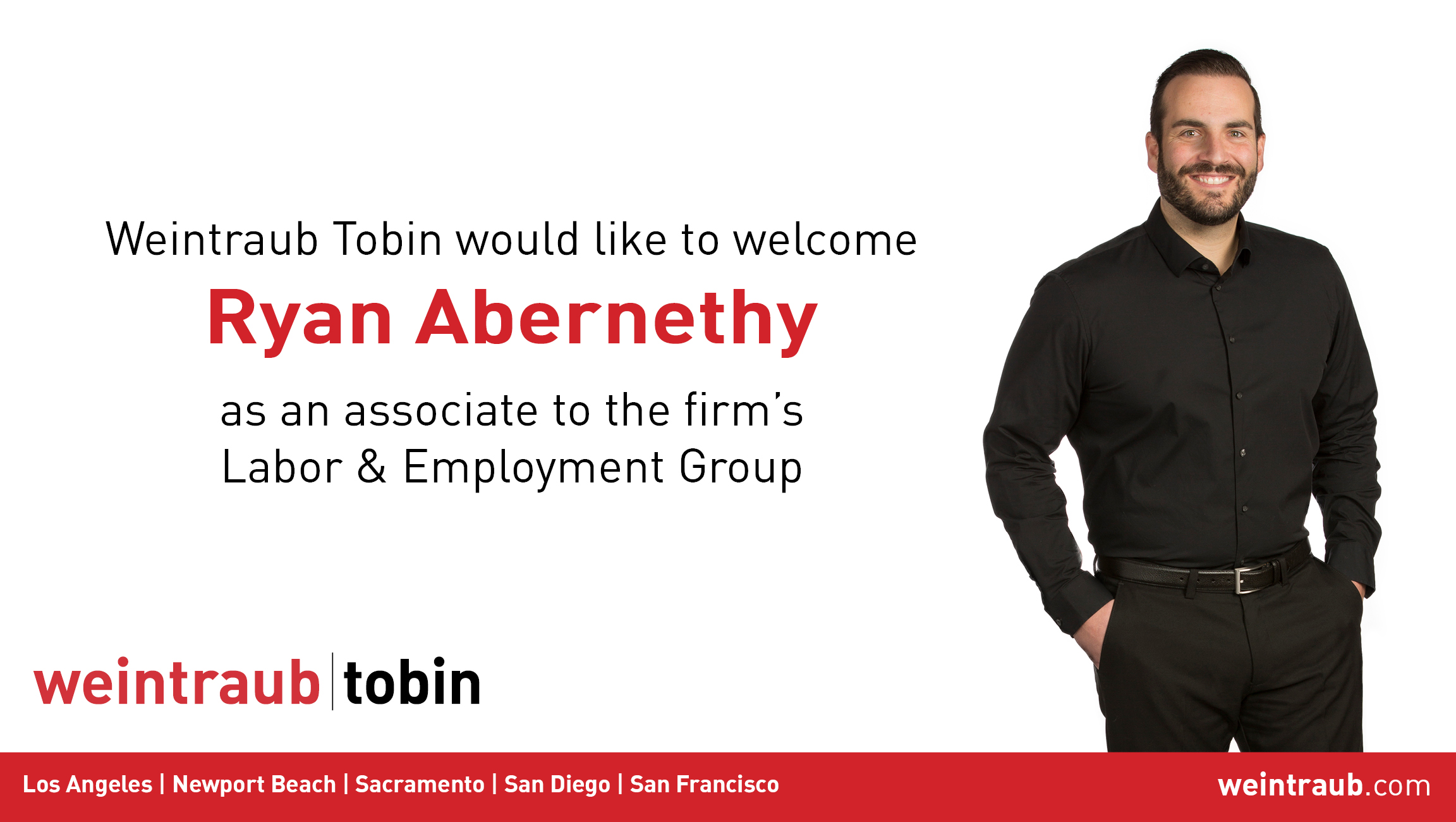
Weintraub Tobin would like to welcome Ryan E. Abernethy to the firm

Ryan Abernethy is an associate in the firm’s Labor and Employment practice group. Ryan has successfully represented clients in all areas of employment law including the defense of claims involving workplace discrimination, harassment, retaliation, wrongful termination, wage and hour issues, trade secrets infringements and class actions.  He also regularly counsels clients regarding compliance, risk management, policy preparation and training.

To learn more about Ryan and his practice, visit his attorney page: https://www.weintraub.com/people/ryan-e-abernethy

New Transgender Rights Poster Required for California Workplaces

By Michelle Covington

On October 15, 2017, California’s Governor Jerry Brown signed SB 396 into law, requiring new training and posters for California employers.  Currently, California law requires employers with 50 or more employees to provide at least 2 hours of sexual harassment training to supervisors every two years.  This new bill requires those employers to also include training on harassment based on gender identity, gender expression, and sexual orientation.  Further, employers will be required to display a poster regarding transgender rights.  The poster can be obtained from the Department of Fair Employment and Housing or by clicking here.   The bill is set to go into effect on January 1, 2018.  Our Labor and Employment attorneys are available to ensure that your training materials and posters comply with these new requirements.