

Welcome to the Weintraub Tobin Resources Page

Browse below for news, legal insights, information on presentations and events, and other resources from the Weintraub Tobin legal team.


New (and Stricter) COVID-19 Rules Implemented By Cal/OSHA – Employers Should Act Now

On November 30, 2020, the California Division of Occupational Safety and Health’s (“Cal/OSHA”) Emergency COVID-19 Prevention Regulation went into effect. The regulations apply to all employers, employees, and to all places of employment with three exceptions: (1) workplaces where there is only one employee who does not have contact with other people; (2) employees who are working from home; and (3) employees who are covered by the Aerosol Transmissible Diseases regulation.

The emergency regulations provide additional requirements on employers in light of the COVID-19 pandemic in the following areas: COVID-19 prevention, the handling of COVID-19 infections and COVID-19 outbreaks (including major outbreaks), COVID-19 prevention in employer-provided housing, and COVID-19 prevention in employer-provided transportation to and from work. Employers should review the regulations in detail to understand how their own workplace might be affected. Among the issues addressed by the emergency regulations, are the following:

  1. Employers must adopt a written COVID-19 Prevention Program containing the following information:
  • Communication to employees about the employer’s COVID-19 prevention procedures
  • Identify, evaluate and correct COVID-19 hazards
  • Physical distancing of at least six feet unless it is not possible
  • Use of face coverings
  • Use engineering controls, administrative controls and personal protective equipment as required to reduce transmission risk
  • Procedures to investigate and respond to COVID-19 cases in the workplace
  • Provide COVID-19 training to employees
  • Provide testing to employees who are exposed to a COVID-19 case, and in the case of multiple infections or a major outbreak, implement regular workplace testing for employees in the exposed work areas
  • Exclusion of COVID-19 cases and exposed employees from the workplace until they are no longer an infection risk
  • Maintain records of COVID-19 cases and report serious illnesses and multiple cases to Cal/OSHA and the local health department, as required
  1. Guidance on dealing with employees who are COVID-19 positive, or who have been exposed to the illness. Specifically, employers are directed to exclude COVID-19-positive employees and those who have been exposed to COVID-19 from the workplace. If the employee is able and available to work, the employer must continue to provide the employee’s pay and benefits, unless the employer can establish the employee’s exposure was not work-related. The employer may require the employee to exhaust paid sick leave benefits before providing exclusion pay, and may offset payments by the amount an employee receives in other benefit payments.
  2. Specific guidance on what additional actions employers must take amidst a major COVID-19 outbreak, which is defined as a covered workplace that has 20 or more COVID-19 cases within a 30 day-period.

Employers can find more information on the Cal/OSHA COVID-19 Guidance and Resources website here, (link https://www.dir.ca.gov/DIRNews/2020/2020-99.html. In addition, FAQ’s on the emergency regulations can be found here (link https://www.dir.ca.gov/dosh/coronavirus/COVID19FAQs.html).

These emergency regulations are now in effect. Employers should immediately review their Cal/OSHA COVID-19 Prevention Plans to ensure compliance with the new regulation. In many cases, employers will need to revise and update their plans, and payroll procedures previously implemented, in order to comply with these new emergency regulations.

The Labor and Employment attorneys at Weintraub Tobin continue to wish you and your family good health during these challenging times.  If we can assist you in any of your employment law needs, feel free to reach out to us.
DFEH Issues Frequently Asked Questions Regarding California’s New Pay Data Reporting Law Under the Equal Pay Act

On September 30, 2020 Governor Newsom signed Senate Bill 973 which requires large employers to report certain pay and other data to the Department of Fair Employment and Housing (DFEH) by March 31, 2021 and annually thereafter. On November 2, 2020, the DFEH issued certain FAQs regarding this new obligation and announced that it anticipates rolling out a secure online reporting system in advance of the 2021 filing deadline.

Below are a few of the DFEH’s FAQs.

Why does California require large employers to report pay data to DFEH?

(11/02/2020) In SB 973, the California Legislature required employers of 100 or more employees to report to DFEH pay and hours-worked data by job category and by sex, race, and ethnicity (hereinafter “pay data”). In enacting this legislation, the Legislature found that “[d]espite significant progress made in California in recent years to strengthen California’s equal pay laws, the gender pay gap persists, resulting in billions of dollars in lost wages for women each year in California. Pay discrimination is not just a women’s issue, but also harms families and the state’s economy. In California, in 2016, women working full time, year round made a median 88 cents to every dollar earned by men, and for women of color, that gap is far worse. Although there are legitimate and lawful reasons for paying some employees more than others, pay discrimination continues to exist, is often ‘hidden from sight,’ and can be the result of unconscious biases or historic inequities.”

By creating a system by which large employers report pay data annually to DFEH, the Legislature sought to encourage these employers to assess themselves pay disparities along gendered, racial, and ethnic lines in their workforce and promote voluntary compliance with equal pay and anti-discrimination laws. In addition, SB 973 authorized DFEH to enforce the Equal Pay Act (Labor Code section 1197.5), which prohibits unjustified pay disparities. The Fair Employment and Housing Act (Gov. Code § 12940 et seq.), already enforced by DFEH, prohibits pay discrimination. Employers’ pay data reports will allow DFEH to more efficiently identify wage patterns and allow for effective enforcement of equal pay or anti-discrimination laws, when appropriate. DFEH’s strategic vision is a California free of discrimination.

Will DFEH’s pay data reporting system be similar to the one used by the EEOC to collect EEO-1 Component 2 data?

(11/02/2020) To ease reporting by employers, DFEH is endeavoring to create a system that closely resembles the EEOC’s system to the extent permitted by state statute.

 What is the deadline for employers to submit their pay data report(s) to DFEH?

(11/02/2020) Under Government Code section 12999(a), employers must submit their pay data reports to DFEH on or before March 31, 2021, and then on or before March 31 each year thereafter.

 What are the penalties for employers who fail to file?

(11/02/2020) “If [DFEH] does not receive the required report from an employer, the department may seek an order requiring the employer to comply with these requirements and shall be entitled to recover the costs associated with seeking the order for compliance.” Gov. Code § 12999(h).

Will an employer’s pay data be publicly available?

(11/02/2020) Government Code 12999(i) prohibits DFEH, the Division of Labor Standards Enforcement (DLSE), and their staff from making “public in any manner whatever any individually identifiable information obtained pursuant to their authority under this section prior to the institution of an investigation or enforcement proceeding by [DFEH and/or DLSE] under Section 1197.5 of the Labor Code or Section 12940 involving that information, and only to the extent necessary for purposes of the enforcement proceeding. For the purposes of this section, ‘individually identifiable information’ means data submitted pursuant to this section that is associated with a specific person or business.”

The DFEH advises that further guidance is coming soon in updated FAQs on the following topics:

  • What information/content is required in an employer’s report.
  • Further information on the definition of “pay.”
  • Further information on the definition of “hours worked.”
  • Information regarding multi-establishment employers.
  • Information on reporting obligations in connection with acquisitions and mergers.

The DFEH advises that it will be regularly updating the FAQs and it invites employers to write to the DFEH at paydatareporting@dfeh.ca.gov to pose additional questions. The DFEH’s FAQs can be found at https://www.dfeh.ca.gov/paydatareporting/.

******

The Labor and Employment attorneys at Weintraub Tobin assist employers in all aspects of their employment law compliance, including compliance with California’s Equal Pay Act.  Please feel free to reach out to any of the attorneys if we can be of assistance to you in your employment law compliance.  Stay healthy and stay safe.

DFEH Updates “Ban the Box” Regulations and Provides FAQ

Since its implementation on January 1, 2018, The Fair Chance Act has been a source of questions for California employers. Also referred to as “banning the box,” Government Code section 12952 makes it illegal for most employers in California to ask about the criminal record of job applicants before making a conditional job offer. You can refer to our previous blog on the subject here.

The Department of Fair Employment and Housing (“DFEH”) recently amended the regulations implementing the law, with an effective date of October 1, 2020. Among the updates are the following:

  • An expanded definition of  an “applicant” to include individuals who begin work before an employer’s review of their criminal history. Specifically, the regulations state that “[a]n employer cannot evade the requirements of [the FEHA] or this regulation by having an individual lose their status as an ‘applicant’ by working before undertaking a post-conditional offer review of the individual’s criminal history.”
  • A clarification that the Act must be complied with even when selecting workers supplied by labor contractors and union hiring halls.
  • An explanation that employers who are required by law to conduct criminal background checks, do not have a full exemption from the Fair Chance Act. The regulations specify that employers may not utilize records not permitted for disclosure by law, and that such employers must still be able to justify their policies. As the regulations state, “[c]ompliance with federal or state laws or regulations that mandate particular criminal history screening processes, or requiring that an employee or applicant possess or obtain any required occupational licenses constitute rebuttable defenses to an adverse impact claim under the Act.”
  • A direction that “[w]hile employers are prohibited from considering referral to or participation in a pretrial or post-trial diversion program, it is permissible to consider these programs as evidence of rehabilitation or mitigating circumstances after a conditional offer has been made if offered by the applicant as evidence of rehabilitation or mitigating circumstances.
  • A reminder that in addition to following the Fair Chance Act, employers must also ensure compliance with other local laws and ordinances.

In addition, the DFEH published a FAQ, which describes the law, explains how the law works, addresses what employers are covered by the law, and provides guidance as to when employers may inquire into an applicant’s criminal history and (where necessary), rescind a conditional job offer. That FAQ can be found here.

The FAQ and amended regulations demonstrate that the DFEH takes the Fair Chance Act seriously. Employers should take great care in understanding the procedures set forth in the Act to promote compliance, and also ensure those individuals within their organization that are charged with hiring are properly trained on intricacies of the Act and how to properly implement it.

Recent Developments at the California Department of Fair Employment and Housing

The California Department of Fair Employment and Housing (“DFEH”) is the state agency charged with enforcing California’s laws against harassment, discrimination, and retaliation in employment, housing, and business establishments throughout the state. It proclaims on its website that it is “the institutional centerpiece of California’s broad anti-discrimination and hate crimes policy.” According to the DFEH, it is the largest state civil rights agency in the country.

Taking its charge seriously, the DFEH has been busy recently implementing new regulations, creating on-line training, and issuing guidance and FAQs in connection with the various laws it enforces.  Below is a summary of some of its most recent activity related to the workplace.

  1. Fair Chance Act: Criminal History and Employment FAQs. In September, 2020, the DFEH issued its FAQs regarding the California Fair Chance Act (CA Government Code section 12952) which is the “ban the box” law that went into effect on January 1, 2018.  The FAQs are written so as to respond to questions that would be posed by an applicant for employment who may have a criminal conviction record, and explains the process an employer must follow under the law before denying employment on the basis of a criminal conviction.  While written for applicants, the FAQs provide helpful information for employers.
  2. On-Line Sexual Harassment Prevention Training. On August 4, 2020, the DFEH announced that it has finally launched the free on-line anti-harassment training for both supervisors and non-supervisory employees pursuant to the mandates of CA Government Code section 12950.1.  California law requires all employers of 5 or more employees to provide 1 hour of sexual harassment and abusive conduct prevention training to non-supervisory employees, and 2 hours of sexual harassment and abusive conduct prevention training to supervisors and managers once every two years. The law requires the training to include practical examples of harassment based on gender identity, gender expression, and sexual orientation.
  3. FAQs Re: Employment and COVID-19. In July, 2020, the DFEH issued its FAQs to provide guidance to employers and employees about how to keep the workplace safe during the COVID-19 pandemic while at the same time upholding civil rights laws.  It reiterates that civil rights laws are still in place during the pandemic, but explains how employers may make various inquiries and/or conduct certain health screenings of employees in order to protect the workplace from the spread of the virus.
  4. LGBTQ Fact Sheet. In June, 2020, the DFEH issued its Fact Sheet concerning LGBTQ rights in employment, as well as in housing and business establishments.  The Fact Sheet explains that it is unlawful for employers, landlords, businesses of all kinds, health care providers and insurers, homeless shelters, state funded programs and services, and others to discriminate against anyone or treat them unequally because of their sexual orientation, gender identity, gender expression, or sex.
  5. Hearing on Hate Violence. Finally, on September 21, 2020, the DFEH’s Fair Employment and Housing Council held a virtual public hearing about hate violence in California.  The purpose was to discuss certain interventions to reduce violence motivated by bias against someone’s race, national origin, religion, sexual orientation, gender identity, sex, or other personal characteristic.  While the DFEH already has resources to address hate violence, it is likely that further information and resources will be forthcoming given the DFEH’s deeper dive into the subject.

More information on the above recent DFEH resources, as well as others, can be obtained from the DFEH website at: https://www.dfeh.ca.gov/

The Labor and Employment attorneys at Weintraub Tobin have years of experience counseling and defending employers in all areas of employment law, including the civil rights laws enforced by the DFEH.  If we can be of assistance to you in your compliance with the law, and/or defense of a claim, feel free to reach out to us.  Stay health and safe.

New California Laws Create Presumption of Workers’ Compensation Coverage for COVID-19 Infections and Impose Additional COVID-19 Exposure Reporting and Notice Requirements on Employers

California Gov. Gavin Newsom signed Executive Order N-62-20—way back on May 6, 2020—which created a presumption that employees’ COVID-19-related illnesses were caused at work and therefore covered by workers’ compensation. That order covered COVID-19 infections from March 19, 2020 to July 5, 2020, at which time the order expired. To fill the void, on September 17, 2020, Gov. Newsom signed Senate Bill (“SB”) 1159 and Assembly Bill (“AB”) 685 into law.

SB 1159 resets the rebuttable presumption establishing workers’ compensation benefits for certain employees who contract COVID-19. At the same time, California passed AB 685, which allows the state to more closely track COVID-19 cases in the workplace by requiring employers to timely report COVID-19 related exposure information to the California Division of Occupational Safety and Health (“Cal/OSHA”). AB 685 also requires employers to provide notice to employees of workplace COVID-19 exposures.

To read the full article, please click here.

California Drastically Alters Obligations under the California Family Rights Act

On Thursday, Governor Newsom signed Senate Bill 1383, dramatically expanding the California Family Rights Act (“CFRA”), and the obligations it places on employers to provide leave to eligible employees. As a reminder, the CFRA is California’s leave statute, which authorizes eligible employees to take up a total of 12 weeks of unpaid job-protected leave during a 12-month period. While on leave, employees keep the same employer-paid health benefits they had while working.

Historically, the CFRA has applied to employers employing at least 50 employees. SB 1383 expands the CFRA to employers throughout the state who employ 5 or more employees.  In addition, SB 1383 expands the definition of a “family member” to include adult children, siblings, grandparents, grandchildren and domestic partners. The changes go into effect on January 1, 2021.

DOL Revises COVID-19 Sick Leave and Family and Medical Leave Rules Following Court Ruling

On September 11, 2020, the United States Department of Labor issued revised regulations governing the Families First Coronavirus Response Act (FFCRA). The regulations implement the Emergency Paid Sick Leave Act (EPSLA) and Emergency Family and Medical Leave Expansion Act (EFMLEA) provisions of the FFCRA. The revised regulations were issued to address a decision from a federal court in New York that invalidated previous regulations concerning whether work must otherwise be available to employees seeking to use leave under EPSLA and EFMLEA and whether an employer must consent to intermittent leave. The revised regulations also clarify and narrow the definition of “health care provider” under the FFCRA and address medical documentation requirements employees must meet to be eligible to take leave.

Refresher on FFCRA

In March 2020, at the outset of the COVID-19 pandemic, Congress enacted the FFCRA. We initially blogged about the FFCRA here. In short, the FFCRA requires employers with 500 or fewer employees to offer up to 2 weeks of EPSLA leave to employees who miss work for qualifying reasons relating to the pandemic. Where the need to miss work results from the employee’s need to stay home with a child whose school or childcare facility is closed due to the pandemic, employees may take up to 12 weeks of paid and unpaid leave under EFMLEA. The first two weeks of EFMLEA leave are unpaid, but employees seeking pay could  choose to use EPSLA leave or any other paid leave otherwise available to the employee such as state law sick leave or any accrued paid vacation benefits. The last 10 weeks of EFMLEA leave are paid. Employers may receive a tax credit for any leave paid out under the FFCRA. Unless extended, the FFCRA is set to expire at the end of 2020.

New York Opinion Invalidates Certain FFCRA Regulations

Last month, in response to a challenge brought by the New York Attorney General, a federal court struck down four provisions of the FFCRA’s prior regulations.  Specifically, the court struck down regulations requiring work to be otherwise available to employees before they can qualify for EPSLA or EFMLEA, requiring employees to obtain employer approval before taking intermittent leave, and requiring employees to provide medical documentation regarding the reasons for leave “prior to” taking the leave. Finally, the court struck down as overbroad the FFCRA’s definition of “health care provider” as used to determine those health care providers who were ineligible for the leave.

The Revised Regulations

Following the New York ruling, the DOL was widely expected to issue revised regulations addressing the items the court raised. The September 11, 2020 DOL release does just that. According to the DOL’s news release, found here, the revisions do the following:

  • Reaffirm and provide additional explanation for the requirement that employees may take FFCRA leave only if work would otherwise be available to them.
  • Reaffirm and provide additional explanation for the requirement that an employee have employer approval to take FFCRA leave intermittently.
  • Revise the definition of “healthcare provider” to include only employees who meet the definition of that term under the Family and Medical Leave Act regulations or who are employed to provide diagnostic services, preventative services, treatment services or other services that are integrated with and necessary to the provision of patient care which, if not provided, would adversely impact patient care.
  • Clarify that employees must provide required documentation supporting their need for FFCRA leave to their employers as soon as practicable.
  • Correct an inconsistency regarding when employees may be required to provide notice of a need to take expanded family and medical leave to their employers.

Work Availability Requirement

The DOL’s position that work must be available to an employee seeking to take leave reflects a doubling down on their regulation that the court struck down. Recognizing the court’s opinion that the prior regulation lacked sufficient analysis of why work must be available to the employee, the DOL provided that analysis. The DOL clarified that when work is unavailable due to circumstances other than a FFCRA-qualifying reason, such as when an employee is furloughed or the business is temporarily shut down, there is no work available from which an employee can take leave.

The DOL further explained that “leave is most simply and clearly understood as an authorized absence from work; if an employee is not expected or required to work, he or she is not taking leave.” In those circumstances, an employee’s recourse may instead be to file for unemployment insurance benefits. The revised regulation does, however, make clear that employers cannot withhold work in order to avoid paying EFMLEA or EPSLA. Instead, work must be unavailable for legitimate business reasons.

Employer Consent to Intermittent Leave

Just as with the work availability requirement, the New York court struck down the requirement that employees taking intermittent EPSLA or EFMLEA leave must obtain employer consent because, according to the court, the DOL’s initial rule lacked sufficient analysis and explanation for the requirement. Again, the DOL doubled down on its prior rule while providing much more detailed reasoning for it. The DOL noted that the FMLA provides for intermittent leave only for qualifying reasons, such as medical necessity and employer/employee agreement. Because the FFCRA is silent on employees’ ability to take intermittent leave, and because the “medical necessity” basis for leave under the FMLA does not fit within the EFMLEA framework, the DOL concluded that it had discretion to balance employees’ need for leave with employers’ need to avoid business disruptions. It balanced those competing interests by requiring employees to obtain employer consent to take intermittent leave.

Narrowed Definition of Health Care Provider under Exemption

The FFCRA exempts employers from offering EFMLEA or EPSLA to certain health care providers. The previous definition, which the New York court struck down as too broad, included “anyone employed at” any location “where medical services are provided.” This could have included those workers at the facilities who did not even provide healthcare services, such as IT staff, human resources, or kitchen workers. Under the revised rule, “[a] person is not a health care provider merely because his or her employer provides health care services or because he or she provides a service that affects the provision of health care services.” Rather, the employee must meet the definition of healthcare provider under the FMLA (essentially, those workers who directly provide the healthcare services), or those who are “employed to provide diagnostic services, preventive services, treatment services or other services that are integrated with and necessary to the provision of patient care and, if not provided, would adversely impact patient care.”

Notice and Documentation Requirements

Under the prior rules, struck down by the New York court, employees were required to provide employers with notice of the need for FFCRA leave, and documentation supporting the need for leave, prior to being eligible. Under the revised regulation, employees are now only required to provide notice and documentation “as soon as practicable.”  The DOL did note, however, that in the cases of employees needing leave due to a child’s school closure, the leave will almost always be foreseeable in advance and should therefore be provided prior to the leave being taken.

Takeaway for Employers

For now, employers can follow the new DOL regulations in administering FFCRA leave. That means employers are not obligated to provide EFMLEA or EPSLA leave to employees who are furloughed or are otherwise unable to work for reasons that do not relate to the COVID-19 pandemic. Employers may also decide whether to allow employees intermittent leave under the FFCRA. Such decisions, however, should be made for legitimate business reasons and applied consistently to avoid the risk of discrimination claims. Employers in the healthcare industry may utilize the updated definitions of healthcare provider in assessing whether employees are eligible for FFCRA leave. Finally, employers should not require employees to provide notice and documentation supporting their need for FFCRA leave any earlier than is practicable under the circumstances.

Employers should also watch for future developments around these regulations. First, it is not yet known whether they will be subjected to any further court challenges and, if so, what the outcome of those challenges will be. Employers should also monitor whether Congress elects to extend the FFCRA, with or without modifications, beyond its current expiration date of December 31, 2020. Employers with any uncertainty in these areas should work with their legal counsel to assure their practices and policies are compliant.

Governor Newsom Signs AB 2257 – More Clarifications and Exceptions to the “ABC Test” for Independent Contractor Status

On September 4, 2020, Governor Newsom signed AB 2257, a bill that provides comprehensive clarifications and changes to the very controversial bill – AB 5 – that went into effect in January 2020 and requires the use of the “ABC Test” to determine independent contractor status for most employment laws in California.  AB 2257 brings some good news to businesses in various industries who utilize independent contractors, and provides needed clarification to a number of ambiguities in the text of AB 5.

To read the full white paper, please click here.

California Issues New Reopening Guidance

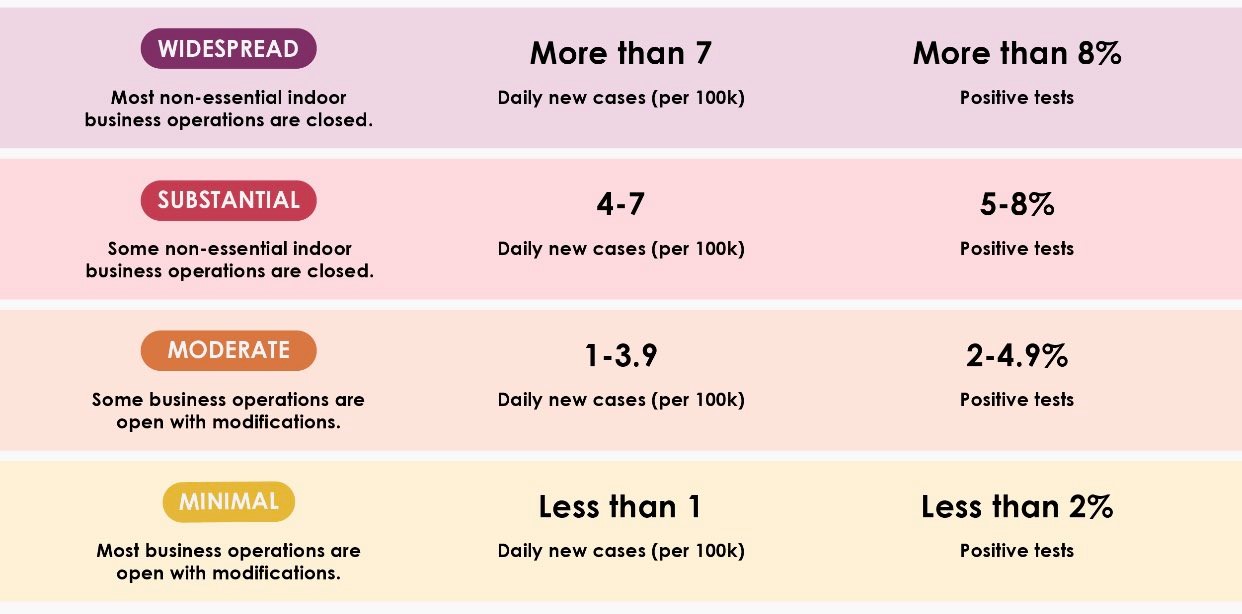
On August 28, 2020, California introduced the Blueprint for a Safer Economy, also known as “California’s Plan for Reducing COVID-19 and Adjusting Permitted Sector Activities to Keep Californians Healthy and Safe.” This new Blueprint was devised to aid California residents as the state reopens in the wake of the COVID-19 pandemic. Under this new plan, every county in California is assigned one of four tiers, based on the county’s test positivity and adjusted case rate. A county’s tier will determine what industries are permitted to reopen and what modifications are required.

As defined by the Blueprint, each of California’s 58 counties was assigned to one of the following four tiers based upon the counties health metrics on August 28, 2020, with  Tier 1 (Widespread) being the most restrictive:

(See https://covid19.ca.gov/safer-economy/)

While the California Department of Public Health (“CDPH”) will assess and release the health indicators each week, to move to a less restrictive tier, a county must have been in the current tier for a minimum of three weeks, and must meet criteria for the next tier for the prior two weeks, in order to progress to the next tier. Further, a county can only move forward one tier at a time, even if metrics qualify that county for a more advanced tier. Alternatively, if during the weekly assessment a county’s adjusted case rate and/or test positivity has been within a more restrictive tier for two consecutive weekly periods, the county must revert to the more restrictive tier.

Much of California remains in the “purple” most restrictive tier, which significantly limits what industry sectors are permitted to reopen. A list of each industry sector, and when it is permitted to be open with modifications, can be found here: https://www.cdph.ca.gov/Programs/CID/DCDC/CDPH%20Document%20Library/COVID-19/Dimmer-Framework-August_2020.pdf. As counties move through the tiers, more industry sectors will be permitted to reopen based upon their perceived risk. The criteria being considered by the State to determine low/medium/high risk sectors includes the following:

  • Ability to wear face covers at all times (e.g. eating and drinking would require removal of face covering)
  • Ability to physically distance between individuals from different households
  • Ability to limit the number of people per square foot
  • Ability to limit duration of exposure
  • Ability to limit amount of mixing of people from differing households and communities
  • Ability to limit amount of physical interactions of visitors/patrons
  • Ability to optimize ventilation (e.g. indoor vs outdoor, air exchange and filtration)
  • Ability to limit activities that are known to cause increased spread (e.g. singing, shouting, heavy breathing; loud environs will cause people to raise voice)

The new public health order can be found here: https://www.cdph.ca.gov/Programs/CID/DCDC/CDPH%20Document%20Library/COVID-19/8-28-20_Order-Plan-Reducing-COVID19-Adjusting-Permitted-Sectors-Signed.pdf, and residents can refer to the Blueprint for a Safer Economy website here: https://www.cdph.ca.gov/Programs/CID/DCDC/Pages/COVID-19/COVID19CountyMonitoringOverview.aspx.

As always, the Labor and Employment attorneys at Weintraub Tobin continue to wish you and yours health and safety during these challenging times.  If we can assist you with your employment law needs, please feel free to reach out to any one of us.

DOL Issues Guidance on FFCRA as Schools Reopen

On August 27, 2020, the U.S. Department of Labor (DOL) published three new “Return to School” FAQs providing guidance for employers and employees as schools reopen across the country. Specifically, the DOL clarified when employees may be eligible for leave under the federal Families First Coronavirus Response Act (FFCRA).

As a reminder, under the FFCRA, job-protected leave must be provided to some employees in order to care for a child whose school or place of care is closed, or childcare provider is unavailable, due to the coronavirus. The newest FAQs address issues employers and employees are facing as schools reopen both virtually, as well as on a “hybrid” model. The DOL further provides guidance on situations where schools have reopened, but the parent chooses a virtual model for their child’s learning.

Scenario 1: School Remains Fully Remote

Many schools across the country (and most in California) are currently only offering remote learning. In FAQ 100, the DOL confirmed that parents are permitted to take paid leave under the FFCRA for as long as the school remains closed to in-person learning.

Scenario 2: School Reopens on a Hybrid Model

Under a hybrid model, a school is typically open, but students alternate between in-person and remote learning. Under FAQ 98, the DOL clarifies that parents are eligible to take paid leave under the FFCRA on days where the child is not permitted to attend school in person, and must instead engage in remote learning. FFCRA leave is not available, however, at times when the child is able to attend school in-person.

Scenario 3: School Reopens, but Parent Chooses Remote Option

Most schools offering in-person learning are also providing a virtual option for parents who are concerned about their child returning to school. The DOL clarifies in FAQ 99 that FFCRA leave is not available to take care of a child whose school is open for in-person attendance. It is worth noting, however, that if the child is under a quarantine order or has been advised by a health care provider to self-isolate or self-quarantine, paid leave might otherwise be available.

The full FAQ’s can be found here (https://www.dol.gov/agencies/whd/pandemic/ffcra-questions). If you have questions as to whether FFCRA applies to you and your employees, and whether paid leave might be available, please contact your Weintraub Tobin labor and employment attorney for help.