Welcome to the Weintraub Tobin Resources Page

Browse below for news, legal insights, information on presentations and events, and other resources from the Weintraub Tobin legal team.


NLRB Panel’s Strict Interpretation Of “You’re Fired”

On July 14, 2016, a three-member panel appointed by the National Labor Relations Board (“NLRB”) reversed an Administrative Law Judge decision in favor of the employee. The Panel found that a complaining employee who was told he was “fired” in a meeting and subsequently told he was not fired after the meeting on the same day, was in fact discharged for purposes of the Act. Thus, the Panel found the employer violated National Labor Relations Act (the “Act”) Section 8(a)(1).

Read more about it here: https://www.nlrb.gov/

EEOC Urges Employers To Revamp Harassment Prevention Practices

Female office worker making shocked expression over man’s hands on her knee.

On June 20, 2016, the Co-Chairs of the EEOC’s Select Task Force on the Study of Harassment in the Workplace issued a 130-page report detailing its findings after 14 months of study of workplace harassment. To the dismay of many employers, the Select Task Force found that workplace harassment remains a persistent problem, and most employers’ harassment prevention training has been ineffective in preventing it.  The Select Task Force urged employers to “reboot” their workplace harassment prevention efforts.

Read about it here: https://www.eeoc.gov/select-task-force-study-harassment-workplace

Small Burger Chain Has a Beef With Chipotle

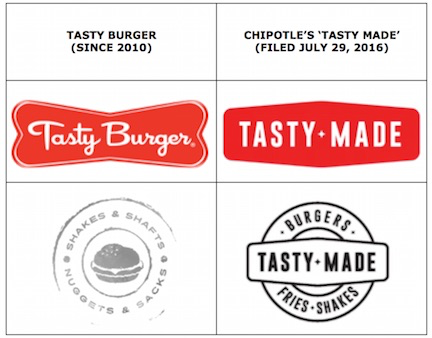
Chipotle’s entry into the burger business has a Boston based small burger chain up in arms.  The Boston burger spot, which has been in operation since 2010 and goes by the name Tasty Burger, has a beef with the brand Chipotle has chosen for its restaurants, Tasty Made.

Tasty Burger claims that Chipotle brand infringes on its trademark,  Despite a cease and desist letter and public threats of a lawsuit, Chipotle has publicly stated that it “fully intend(s) to move forward with the name Tasty Made for our burger restaurant and strongly believe that we are on solid footing in doing so.”

Why might Chipotle feel – or claim to feel – so secure in its brand choice.  Tasty Burger has superior common law rights; it has been using its mark since July 2010.  Additionally, Tasty Burger applied for a Federal trademark registration in December 2010 and was granted federal registration for its trademark in 2012.  On first blush, it seems that Tasty Burger has a strong case.  However, things may not be as they seem.

During the registration process for Tasty Burger’s trademark, the United States Patent and Trademark Office refused to register the trademark for Tasty Burger on the Principal Register because it is merely descriptive.  A mark is merely descriptive if it describes an ingredient, quality, characteristic, function, feature, purpose or use of the specified goods and/or services.  The trademark examiner assigned to the Tasty Burger application argued as follows:

In the present case, applicant is using the mark TASTY BURGER, stylized, and design, in connection with “Restaurant services.”   As indicated in the initial Office action, the wording TASTY BURGER describes good tasting hamburgers, an item presumably offered in applicant’s restaurants.  See the definitions enclosed with the initial Office action.

In addition, the applied-for mark shows the wording in stylized lettering.  However, the degree of stylization in this case is not sufficiently striking, unique or distinctive so as to create a commercial impression separate and apart from the unregistrable components of the mark.  See In re Sambado & Son Inc., 45 USPQ2d 1312 (TTAB 1997); In re Bonni Keller Collections Ltd., 6 USPQ2d 1224 (TTAB 1987). Furthermore, the design consists of a common geometric shape and merely functions as a background carrier for the word portion of the proposed mark.  Accordingly, the entire mark must be deemed to be merely descriptive.

In response to the refusal to register, Tasty Burger abandoned its request for registration on the Principal Register and sought registration on the USPTO’s Supplemental Register.  Marks that do not meet the Principal Register’s requirement of being inherently distinctive but that otherwise meet the technical requirements for registration are registrable on the Supplemental Register.  The benefits and protections for marks registered on the Supplemental Register do not compare to those granted to marks registered on the Principal Register.  Registration on the Principal Register is prima facie evidence of the mark owner’s exclusive right to use the mark nationwide in connection with the goods or services set forth in the registration.  The Supplemental Registration provides no such benefits; the owner of a mark registered on the Supplemental Register must rely on common law rights and must also prove that their mark actually functions as a trademark.

So is Tasty Burger’s claim cooked?  Maybe not.  Merely descriptive trademarks may become protectable through “acquired distinctiveness” or “secondary meaning.”  These are legal concepts by which a term that is descriptive may, through use, has become distinctive of the owner’s goods or services.  One of the ways a mark owner may establish secondary meaning is by showing exclusive and continuous use in commerce for the five years.

Tasty Burger has been using its mark since 2010.  As such, it will be able to establish a prima facie case that its mark is distinctive.  This in and of itself does not mean that Tasty Burger will be able to establish likelihood of confusion; a mark can be distinctive and still be highly suggestive and entitled to little protection.  In order to establish greater protection, Tasty Burger must introduce other evidence of acquired distinctiveness such as declarations from its customers, its advertising and promotional activities and market research and consumer reaction studies.

Tasty Burger will have a strong position to argue that the Chipotle Tasty Made burger chain will infringe its common law rights in its Boston and Washington, DC locations.  Tasty Burger can take certain immediate actions that may increase its strength and leverage but whether Tasty Burger will prevent Chipotle from opening Tasty Made throughout the rest of the US remains to be seen.

Trucking Company Found In Violation Of WARN Act

Often times, when a company acquires another company, it does not wish to retain all of the other company’s employees.  The employees who do not get brought on board often end up out of work.  Under these circumstances, issues arise over how to handle the laid off employees.  Federal law requires employers to provide at least 60-days’ written notice prior to terminating employees affected by such a merger.  So who is required to provide the notice, the employees’ current employer or the new company that does not wish to retain them? Under federal law, if the employees remain employed as of the day of the sale, the purchasing company assumes responsibility for providing the required notice.  According to the 8th Circuit, this remains true even where the purchasing company never intended to employ the laid off workers and expressly contracted away the notice obligation when completing the purchase agreement.

Read more about it here: http://blog.hrusa.com/blog/trucking-company-found-in-violation-of-warn-act/

DOL Issued Updated Employment Law Posters – Be Sure You Post Them In Your Workplace

In July 2016, the federal Department of Labor (DOL) updated two posters that employers are required to post in the workplace.

  1. The “Employee Rights under the Fair Labor Standards Act” poster; and
  2. The “Employee Rights – Employee Polygraph Protection Act” poster.

According to the DOL, every employer subject to the federal Fair Labor Standards Act (FLSA) and the Employee Polygraph Protection Act (EPPA) must post and keep posted on its premises the amended posters after August 1, 2016.  The posters must be posted in a prominent and conspicuous place in every establishment of the employer where it can readily be observed by employees and applicants for employment.

Copies of the posters can be obtained on the DOL website at: https://www.dol.gov/whd/resources/posters.htm

Wearable Technology Raises Concerns Regarding IP, Data Privacy and Data Security

When fashion fuses with high tech, we see our friends show up with trendy wearables, such as smart watches, fitness bands, and even high-tech, designer purses.  But, trendiness aside, wearables raise numerous questions for designers, manufacturers and consumers relating to intellectual property, data privacy and data security.  For example, how does a company protect the technology for its latest smart watch?  Should they rely on patents, trademarks, copyrights or something else?  Who owns the rights to a designer tote with an embedded charging station—the fashion designer or the circuit designer?  Is your employer allowed to collect location and health data via sensor-infused fabric in your work uniform to improve productivity and wellness?  What happens when your fitness band is hacked, revealing personal health data that makes its way to your insurance company?  Can they raise your rates upon learning you have high blood pressure and have stopped working out?

The questions are unending and some answers are still unclear because laws, courts and contracts have not necessarily caught up with advances in this technology.  Further, the fashion and high tech industries have traditionally approached IP protection differently due to the different nature of their products.  Meanwhile, we have seen high-tech industry leaders (e.g., Apple, Fitbit, and Google’s parent, Alphabet), as well as non-practicing entities, actively amassing patents relating to wearables.  This indicates that licensing and litigation will soon escalate as new wearable products arrive in the marketplace.  We have already seen patent litigation related to products such as Ralph Lauren’s Ricky bag, which has an illuminable interior and charger for electronic devices, and Adidas and Textronic’s shirt with special fibers for sensing vital signs and communicating them to a smartphone.  But merely taking off-the-shelf electronics and making them “wearable,” may not be patentable.  Therefore, companies should consider combining patents on novel innovations that make the electronics wearable with other forms of IP protection for appearance, branding and expression to effectively protect their wearable technology.

Despite its recently soaring growth, wearable technology is not new.  For example, the first electronic hearing aid was constructed well over a hundred years ago.  By the 1980s, we saw digital watches with built-in calculators.  But constraints on size, power, weight, etc., limited the development and adoption of early wearable products.  Now, advances in technology have broadened current applications to include fitness, communication, medical monitoring and more.  In addition, tech companies have learned that widespread adoption of wearables requires that these high-tech accessories fit with current fashion trends.  No one wants to wear something that is clunky and doesn’t match their fashion sense or personality, right?  As a result, tech companies have teamed up with designer brands and hired experts from the fashion industry to co-develop and market wearables.

Today, wearables offer convenience and the potential to monitor and/or increase wellness, safety, productivity, sleep, etc.  But the wearer is often not the only one with access to the data collected, which raises privacy concerns and issues regarding data security.  For example, companies often make a wearer sign up for an account or load an app on a phone to use the wearable.  Then these companies collect, process, and perhaps back up the data along with the wearer’s account information.  These companies could share this information with advertisers who then target the wearer with ads for specific products based on current or past location, health statistics, exercise habits, etc.  We see this user-specific advertising on our phones and computers every day.  For example, since I recently searched for information on a particular car, ads for that car and similar cars are showing up when I use Facebook, browsers and other apps.  This example is rather benign, albeit a little annoying given that I already purchased the car I wanted.

But not all examples are so benign.  Now advertisers and others not only have information on your recent Google searches, but may also be able to gain real-time statistics and other information about your stress level, heart rate, blood pressure, location, etc.  The risks associated with dissemination of your health, location, and financial data are much higher than the mere sharing of information about a car you are interested in purchasing.  These risks also raise additional liability concerns for companies if the data is stolen or misused.  Therefore, it is crucial that companies safeguard against data breaches and understand the privacy rights of their employees and customers.  Some companies are even purchasing cyber insurance as protection against data breaches.  But merely having an insurance policy is not enough.  If your company doesn’t have the proper safeguards in place, such as updated security patches and practices, then the insurance company may not have to pay.

To advise clients in this area, attorneys must be knowledgeable about the technology and the integration of technology with fashion, as well as the legal issues surrounding IP, data privacy and data security.  For a particular client and product, it is critical to develop an integrated approach that effectively provides protection via a combination of utility and design patents, trade secrets, copyrights, trademarks and where appropriate, the lesser-used trade dress protection.  The goal is to use the appropriate IP mechanisms to protect all facets of wearable technology, including the electronics, software, functionality, packaging, marketing materials, appearance and the branding associated with it, while avoiding liability from breaches of data privacy or security.

Restaurant’s Fee Deduction Program Violates FLSA

Employers whose workers earn most of their compensation through tips, such as restaurant employees, know that they walk a fine line to ensure compliance with the Fair Labor Standards Act (“FLSA”) and numerous other laws.  Last month the Fifth Circuit rejected a program instituted by a restaurant operator in Texas that deducted certain fees before paying tips to its restaurant workers that were earned by customers using credit cards. While the ruling does not close the door on such arrangements, employers who utilize such programs will be under scrutiny to ensure strict compliance with the FLSA.

Read more on it here: http://blog.hrusa.com/blog/restaurants-fee-deduction-program-violates-flsa/

Window Closes Today! Employer Should Provide Notice Before this Opportunity is Gone!

By: Jessica Schoendienst

WINDOW CLOSES TODAY!

Employers who wish to take advantage of the safe harbor provision of California’s new piece rate legislation, must provide notice to the Director of Industrial Relations by July 28, 2016. The deadline for employers to provide notice was temporarily suspended while a Fresno Superior Court considered a petition by Nisei Farmers League requesting a preliminary injunction to prevent the implementation of the safe harbor provisions of Labor Code section 226.2 created by AB 1513. The temporary restraining order was issued in the case of Nisei Farmers League v. California Labor and Workforce Development Agency, et al., (Case No. 16 CECG 02107). The original deadline for employers to provide notice to the Director of Industrial Relations was July 1, 2016.

On July 18, 2016, the court heard arguments from the parties on whether a preliminary injunction should be ordered pending formal trial on the question of whether a permanent injunction will be issued. On July 25, 2016, the court denied the Nisei Farmers League’s motion for preliminary injunction. Per the court’s Order to show cause, the deadline for employers to provide notice of their election to take advantage of the safe harbor provisions of Labor Code section 226.2(b)(3) is July 28, 2016.

The Director of Industrial Relations will accept notice through 11:59 p.m. on July 28, 2016, but will not accept noticed received after that date. Employers should provide notice by the end of today by mailing notice to the Director of Industrial Relations, Attn: Piece-Rate Section, 226.2 Election Notice, 1515 Clay Street, 17th Floor, Oakland, CA 94612 or by filling out the online form available on the Department of Industrial Relations website.

Trademark Assignability Laid Bare

Crazy Horse was a legendary Native American chief of the Oglala Lakota tribe who lived during the second half of the 1800s.  Unfortunately today, his name may be more familiar as a brand for various products, such as motorcycle gear, whiskey, rifles and strip clubs.  In Russell Road Food & Beverage, LLC v. Spencer, et al., the Ninth Circuit was faced with the issue of the assignability of the trademark “Crazy Horse” in a lawsuit between two strip club operators in Las Vegas, Nevada.

In Paris in 1951, Alain Bernardin, opened the infamous “Crazy Horse Saloon.”  Since that time, the “Crazy Horse” mark has seen numerous trademark battles beginning in 1967 London.  During the 1970’s, Crazy Horse night clubs opened throughout the United States, from Alaska to Florida.

In January 2006, a strip club owner from the Carolinas, Carl Reid, successfully registered the “Crazy Horse” and “Pure Gold’s Crazy Horse” marks with the USPTO for “entertainment services, namely, exotic dance performances.”  Years later, Russell Road and Spencer each attempted to register their respective “Crazy Horse” marks for their strip clubs but the USPTO rejected both of them on the grounds of “a likelihood of confusion with the Reid’s previously registered marks.”  Russell Road and Spencer then pursued different methods to secure the right to use the “Crazy Horse” mark.

Russell Roads obtained the right to use the “Crazy Horse” mark through an agreement with another strip club operator of the “Crazy Horse Too” clubs in Las Vegas.  In September 2007, the owner of that club sought to register the mark “Crazy Horse Too” but like the other “Crazy Horse” marks, the USPTO rejected it. Crazy Horse Too initiated a cancellation proceeding to which Reid, the original owner of the “Crazy Horse” mark, failed to timely respond.  A default was entered but before a default judgment could be rendered in favor of Crazy Horse Too, Reid and the owner of Crazy Horse Too agreed to resolve the dispute through a trademark co-existence agreement.  Under that agreement, Crazy Horse Too agreed to withdraw its challenge to the “Crazy Horse” mark and Reid consented to Crazy Horse Too’s “use and registration” of “any mark that includes the phrase Crazy Horse provided the mark does not contain the phrase pure gold.”  In 2011, Crazy Horse Too encountered financial difficulties and was dissolved.  A year later, Russell Road bought Crazy Horse Too’s rights under the trademark co-existence agreement for $2,500.

Spencer, on the other hand, went straight to the source. In August 201, Spencer formed Crazy Horse Consulting, Inc. (“CHC”) for the purpose of expanding the “Crazy Horse” brand. Later that year, Reid assigned his rights in the “Crazy Horse” trademark to CHC and the assignment was registered with the USPTO.

Following the registration, Spencer learned that Russell Road had a strip club in Las Vegas called Crazy Horse III.  Spencer notified Russell Road that its use of the “Crazy Horse” mark infringed on his trademark rights.  Rather than seeking a license from Spencer, Russell Road entered into a further assignment agreement with the former owner of Crazy Horse Too whereby Crazy Horse Too assigned all of its rights to Russell Road under the September 2009 trademark co-existence agreement.

Russell Road then filed suit against Spencer seeking a declaratory judgment that its use of the “Crazy Horse” mark did not infringe on Spencer’s trademark.  The lower court granted summary judgment to Russell Road finding that it had the right to use the “Crazy Horse” mark under a valid trademark co-existence agreement.  Spencer and CHC appealed that decision to the Ninth Circuit.

The Ninth Circuit began by recognizing that it was undisputed that a trademark owner could assign his or her trademark citing 15 U.S.C. §1060(a)(1).  Furthermore, when a trademark is assigned, the assignee “steps into the shoes of the assignor.”  This means that the assignee not only acquires all of the assignor’s rights, but also assumes any “burdens or limitations” on the use of the mark.  In addition to recognizing the assignability of trademarks, the Ninth Circuit observed that trademark co-existence agreements have long been enforceable.  Furthermore, like other contracts, trademark co-existence agreements could be assignable.

The Ninth Circuit found that the facts showed that it was undisputed that there was a valid trademark co-existence agreement between Reid and Crazy Horse Too.  The Court found that the undisputed evidence showed that Crazy Horse Too had lawfully assigned its rights under that co-existence agreement to Russell Road. Given that Russell Road had obtained the rights that Crazy Horse Too owned, Spencer and CHC had a duty to Russell Road by way of its obligations to Crazy Horse Too “not to oppose each other’s use of the Crazy Horse mark, to make reasonable steps to reduce the likelihood of confusion and so on.” The Ninth Circuit found it significant that the trademark co-existence agreement made it explicit that it would “be binding upon and shall inure to the benefit of the parties hereto, their respective successors, assigns, and licensees.

The Ninth Circuit then turned to various arguments raised by Spencer and rejected each of them in turn.  First, the Ninth Circuit found that the assignment of the trademark rights from Crazy Horse Too to Russell Road was supported by adequate consideration in that Russell Road had paid $2,500 for the assignment.  Next, Spencer argued that because Crazy Horse Too was not using the mark it had essentially “abandoned” it.   The Ninth Circuit found that even if Crazy Horse Too was not using the mark, this did not invalidate the trademark co-existence agreement.  That agreement had no requirement that Crazy Horse Too actually use the mark and therefore the “trademark abandonment” doctrine did not apply.  Spencer also argued that Crazy Horse Too could not assign its rights to Russell Road without Spencer’s consent but the Ninth Circuit rejected this argument finding that Spencer had not raised it with the lower court.

The Ninth Circuit affirmed the lower court’s summary judgment in favor of Russell Road and found that it had properly concluded that there had been a valid assignment of the rights under the trademark co-existence agreement between Reid and Crazy Horse Too.  The Russell Road case is a reminder that parties facing claims of trademark infringement should determine whether there is any basis for their use of a mark, such as through a valid assignment or trademark co-existence agreement.